How to identify a dark-eyed junco
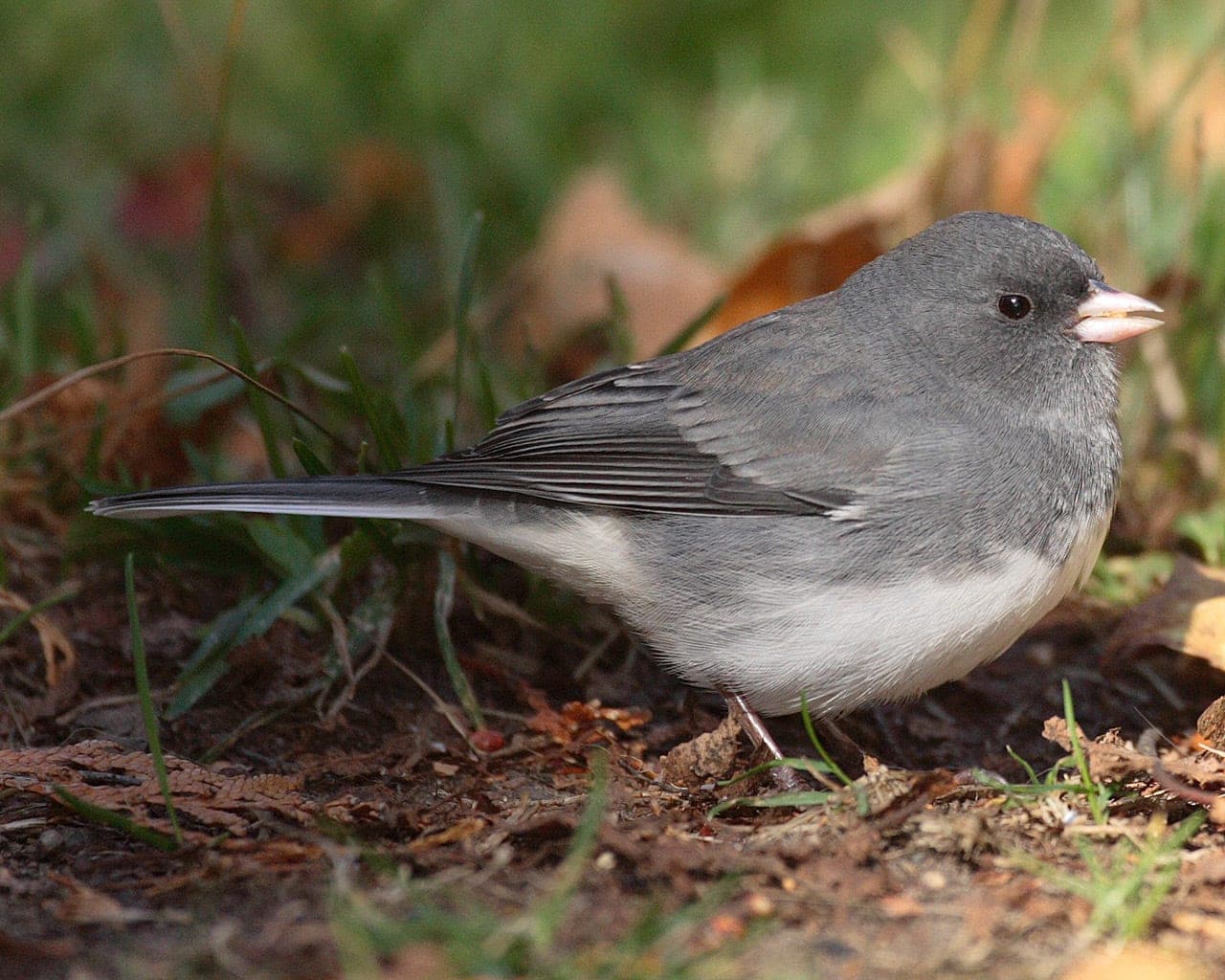
Every junco shares a few traits: a pale pinkish bill, a white belly and white outer tail feathers that flash when it flies or hops. The rest depends on the form. Slate-colored juncos of the East and the North are solid dark gray on the head, back and sides, with females and young washed brown. Oregon juncos, the common form in the West, have a black or gray hood, a chestnut back and rusty or buff sides. Pink-sided juncos have a pale blue-gray hood and pinkish flanks; gray-headed juncos of the southern Rockies have gray sides and a reddish back patch; and white-winged juncos of the Black Hills are bigger and paler, with white wing bars. Summer juveniles are streaky brown and often mistaken for sparrows, but the white tail edges still show.
- White outer tail feathers that flash in flight
- Pale pinkish bill
- Clean white belly sharply set off from a dark hood or breast
- Hops on the ground, often under feeders, rarely on them
- Song is a dry, ringing trill on a single pitch
Look-alikes
Eastern and Spotted Towhees
Towhees are much bigger and longer-tailed, with red eyes, a black bill and bright rufous sides. Spotted Towhees also have white spots on the back and wings. Oregon juncos share the dark hood but are small, pink-billed and plain-winged.
Yellow-eyed Junco
Found in the mountains of southeastern Arizona, southwestern New Mexico and Mexico, it has bright yellow eyes, a two-toned bill and a rufous back, and it shuffles along the ground instead of hopping.
Song Sparrow
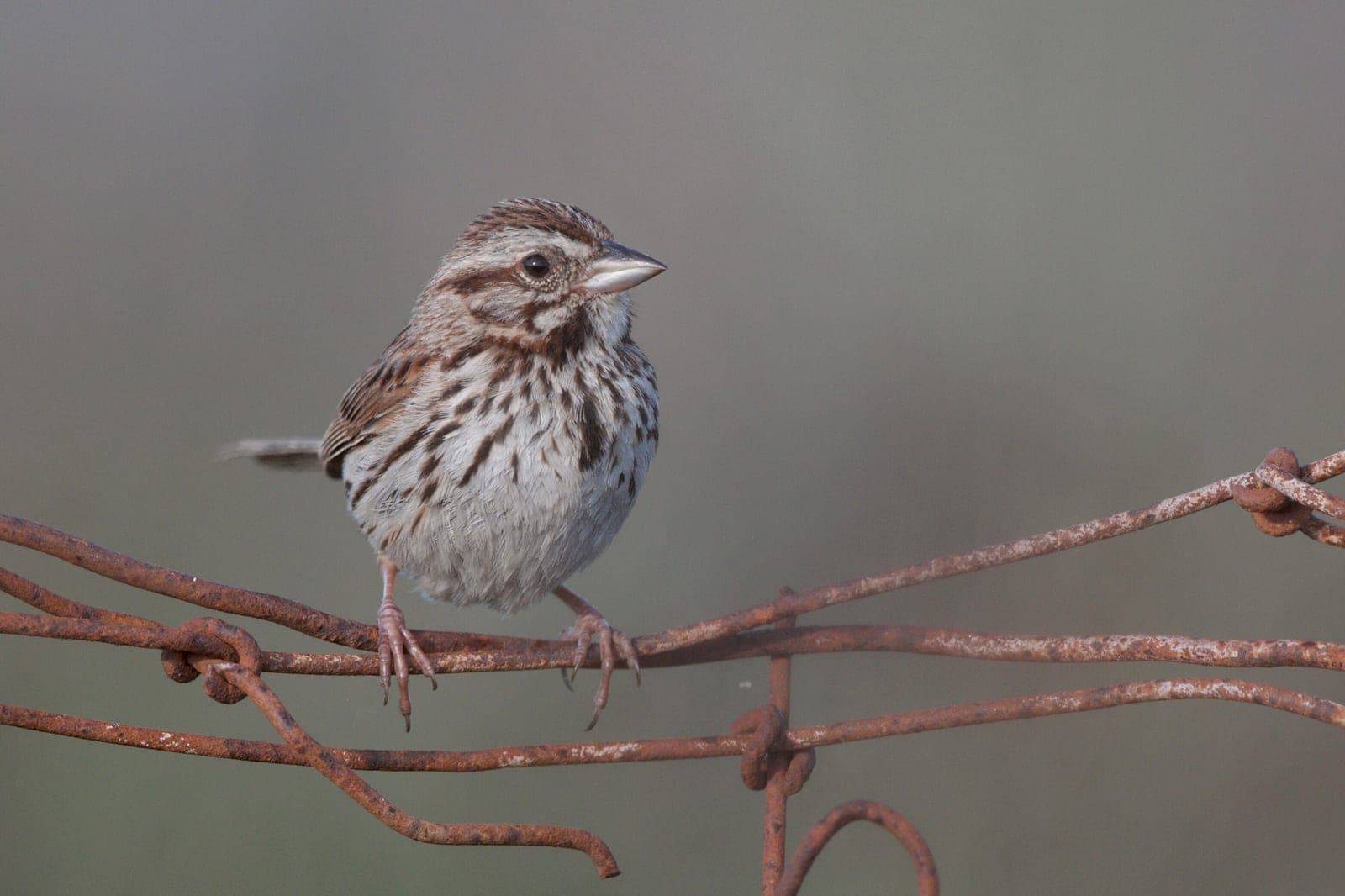
Streaky juvenile juncos in summer can pass for Song Sparrows, but they show white outer tail feathers and a pinkish bill. Song Sparrows have an all-brown tail and a striped face.
Range & habitat
Dark-eyed juncos breed across the boreal forests of Alaska and Canada, through the western mountains south into northern Mexico, along the Pacific Coast, and down the Appalachians to northern Georgia. Northern and high-elevation birds move south or downhill in winter, when juncos spread across nearly all of the lower 48 states. Some mountain populations in the Southwest and along the Pacific Coast stay year-round, including a well-studied group that lives on the University of California, San Diego campus.
In summer, juncos nest in coniferous and mixed forests, especially along edges, clearings, burns, roadsides and bogs, and in western mountain forests up to treeline. In winter they use open woods, brushy edges, weedy fields, roadsides, parks and suburban yards, usually feeding on bare ground or packed snow close to cover.
Through the seasons
Spring
Winter flocks thin out from March into April as birds head north or back up the mountains. Males often start singing their trills around feeders and woodland edges before they leave.
Summer
Juncos nest on the ground in northern and mountain forests, tucking the nest under a log, root, rock or overhanging grass. Streaky juveniles appear by midsummer, and many pairs raise two broods.
Fall
Migrants reach the lower 48 between mid-September and November, often with the first cold fronts, which is where the 'snowbird' name comes from. Males tend to winter farther north than females, so northern feeder flocks skew male.
Winter
Flocks of a dozen or more hop under feeders and along roadsides and woodland edges, trading ticking calls and flashing their white tail feathers when flushed. They stay until March or April.
How to find and attract dark-eyed juncos
In winter, juncos are easy: they visit the ground under almost any seed feeder across most of the country. In summer, you need to go to their breeding forests in the North, the western mountains or the high Appalachians and listen for the dry trill and sharp 'tick' calls.
- Scatter white millet, cracked corn or hulled sunflower on the ground or on a low platform feeder.
- After a snowfall, clear a patch of ground under the feeders; juncos forage on bare ground.
- Leave native grasses and wildflowers standing in fall, and keep a brush pile or evergreens nearby for cover from hawks.
- Watch for the white flash in the tail when a flock flushes; it confirms a junco at a glance.
- In summer, hike conifer forests and mountain trails; in the East, high peaks of the Smokies and Blue Ridge hold breeding juncos.
- Keep cats indoors, since ground-feeding juncos are frequent victims.
Diet & life cycle
What it eats
Seeds make up about three-quarters of a junco's diet over the year, mostly from grasses, weeds and wildflowers, with some berries. During the breeding season nearly half of what adults eat is insects and spiders, including caterpillars and beetles, and the nestlings are raised mainly on insects. Juncos forage by hopping and running on the ground and scratching through leaf litter or snow.
Life cycle
Males sing from treetops to claim territories, and the female builds an open cup of grass, weeds and leaves lined with fine grass, hair or feathers, almost always on the ground under some kind of cover. She lays three to five whitish to pale bluish eggs marked with brown and gray and incubates them for about 11 to 13 days. Both parents feed the young, which leave the nest 9 to 13 days after hatching. Pairs raise one or two broods, sometimes three; on the mild San Diego campus, where juncos no longer migrate, a pair can fit in as many as four.
Oldest on record
The oldest dark-eyed junco in the USGS Bird Banding Laboratory longevity table was at least 11 years and 4 months old. It was banded in West Virginia in August 1991 and recaptured and released there in October 2001.
SourceAttracting & watching
Juncos are ground feeders: millet, cracked corn and sunflower chips scattered on the ground, a low platform or an open tray work best, and a covered spot that stays snow-free helps after storms. Evergreen shrubs and brush piles give them shelter from hawks and wind, and a heated birdbath is a magnet in freezing weather. They do not use nest boxes, and in most yards they are winter guests only.
Conservation
Least Concern (IUCN). Juncos rank among the most numerous birds in North America, with a population Audubon puts around 220 million. Even so, the Breeding Bird Survey shows a decline of about 0.7 percent a year from 1966 to 2019, roughly 31 percent overall. The species is native and protected under the Migratory Bird Treaty Act.