How to identify a anna's hummingbird
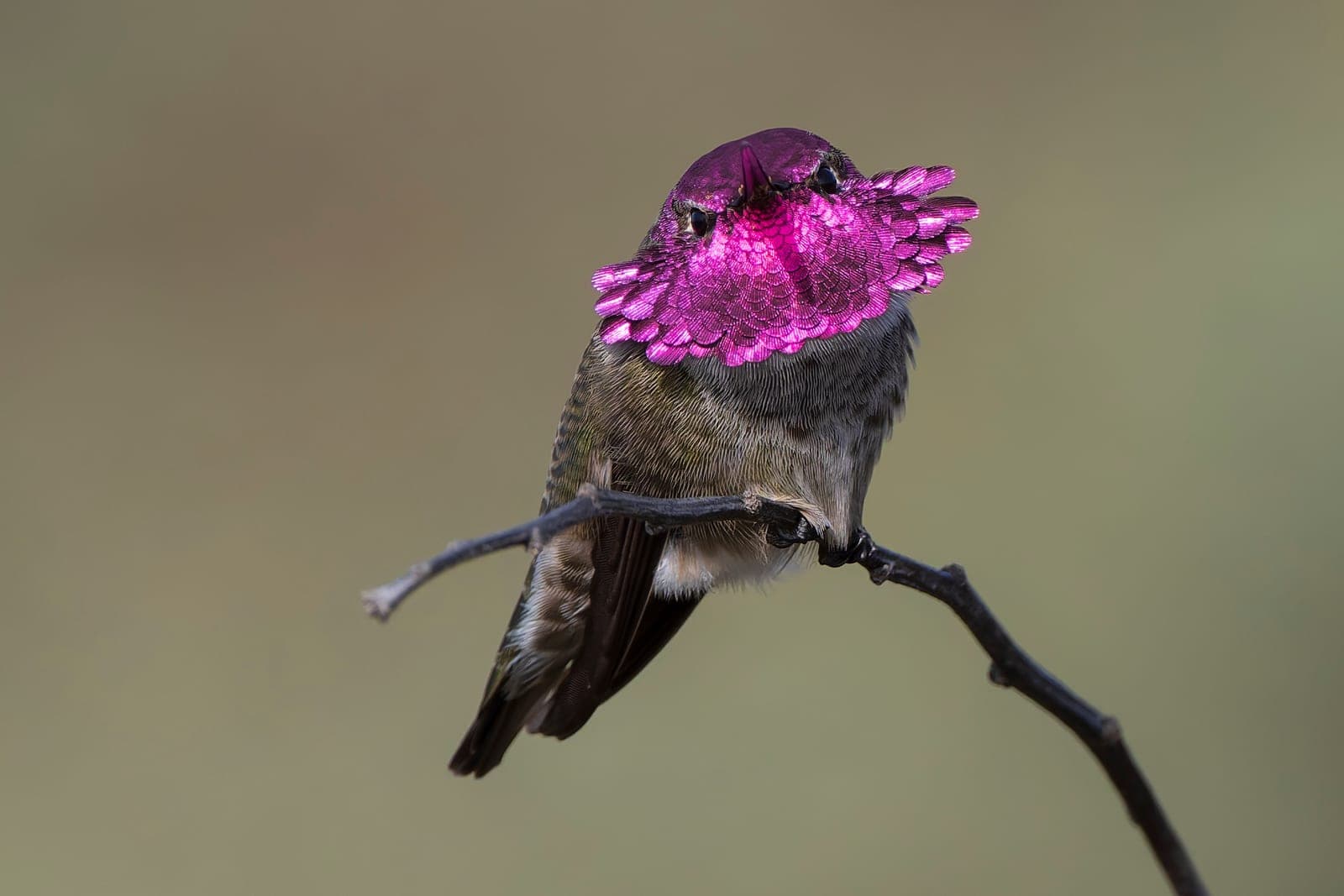
Anna's is a medium-sized, stocky hummingbird with a straight black bill, an iridescent bronze-green back and a grayish chest and belly washed with green on the sides. The adult male's whole head shines: both the crown and the throat gorget are iridescent rose-red to magenta, which can look dull brown, gold or black in shade. He is the only North American hummingbird with a red crown. Females are green above and dingy gray below, and many have a central patch of red spots on the throat; their dark, rounded tails have white tips on the outer feathers. Anna's tends to hold its tail still while hovering, while some similar species pump or wag theirs. Males are unusually vocal and sing a thin, scratchy, buzzy song from a perch.
- Male: rose-red crown and gorget, the only U.S. hummingbird with a red crown
- Stocky build with grayish underparts
- Female: gray throat, often with a central patch of red spots
- Holds the tail fairly still while hovering
- Male sings a scratchy, squeaky song while perched
Look-alikes
Costa's Hummingbird
Costa's is smaller, a desert specialist of the Southwest. The male has a violet-purple crown and a gorget that flares into long points at the sides of the neck. Females are paler and whiter below than female Anna's.
Black-chinned Hummingbird
Males have a black throat with a thin violet band at the bottom and a green crown. Females are slimmer and whiter below than female Anna's, without the red throat spots many Anna's show.
Rufous and Allen's Hummingbirds
Both show rusty-orange on the sides and tail, and males have coppery-orange throats. Anna's shows no rusty-orange on its sides or tail.
Ruby-throated Hummingbird
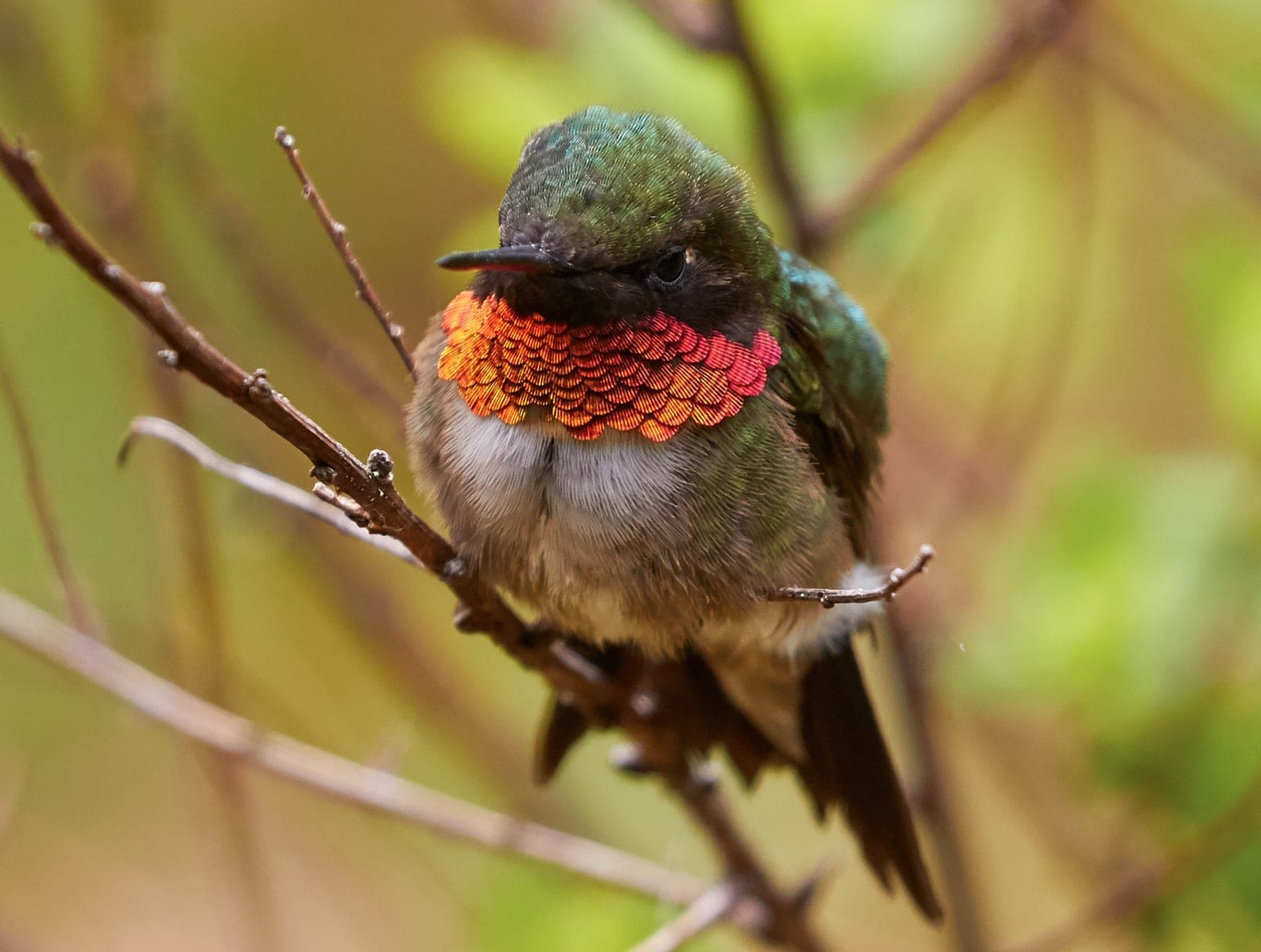
The eastern species, rarely seen in the West. It is smaller and slimmer; the male's red is confined to the throat, and the female's throat is whitish rather than gray with red spots.
Full comparison →Range & habitat
Anna's Hummingbirds live along the Pacific side of North America, from southern British Columbia south through Washington, Oregon and California to northern Baja California, and inland across southern and central Arizona, extreme southern Nevada and into western Texas. Until the mid-20th century they bred only in southern California and northern Baja. Since then they have spread north and east, helped by garden plants and feeders, and they now have the northernmost year-round range of any hummingbird. Strays turn up as far away as Alaska, Newfoundland, Louisiana and Florida.
Anna's thrive in places with flowers year-round: suburban gardens, city parks and yards, along with native chaparral, coastal sage scrub, open oak woodland and streamside groves. They are most common in lowlands and foothills, but some move up to mountain meadows in late summer, and in California they have recently spread higher into ranges such as the Sierra Nevada.
Through the seasons
Spring
By spring many Anna's have already nested, since breeding can begin in December. Many Arizona birds move west to California in mid-spring after nesting, while coastal birds keep raising young into June.
Summer
After breeding, some Anna's wander upslope to mountain meadows full of wildflowers. Arizona birds that left for California return in late summer.
Fall
Most Anna's stay put in their home areas through fall, feeding at gardens and feeders, although researchers think a sizable share of Pacific Northwest birds still move south for the winter.
Winter
Anna's are often the only hummingbird around in winter along the Pacific Coast. On freezing nights they drop into torpor, lowering their body temperature and metabolism, and many depend on feeders until spring flowers open.
How to find and attract Anna's Hummingbirds
In Anna's range, a clean sugar-water feeder kept up year-round, plus flowers that bloom in different seasons, will usually bring in a resident bird. Listen for the male's scratchy song and the sharp 'chip' notes he gives from a favorite perch.
- Mix 1/4 cup refined white sugar in 1 cup boiling water, a 1-to-4 ratio, and let it cool before filling the feeder.
- Do not use red food coloring or honey; the dye is unnecessary and honey can promote dangerous fungal growth.
- Clean feeders often, and keep them out of reach of cats and away from windows.
- In the Pacific Northwest, keep a feeder going through winter; many local Anna's rely on feeders then.
- Plant native nectar plants and flowering shrubs so something is blooming in every season.
- Leave spider webs and lichen-covered branches; females use silk and lichen to build their nests.
- Watch for a male climbing high and then diving with a loud pop at the bottom of the dive.
Diet & life cycle
What it eats
Anna's feed on flower nectar, sugar water and tree sap, and they eat many small insects and spiders for protein. They catch flying insects in midair, pick them off foliage and pluck insects, and sometimes the spiders themselves, from spider webs. Their year-round presence in the Northwest depends heavily on garden flowers and feeders through winter.
Life cycle
Males court by hovering, singing, then climbing about 130 feet and plunging past the female. Near the bottom of the dive they average about 27 meters per second, roughly 60 mph or 385 body lengths per second, and their spread tail feathers make a sharp, explosive chirp. The female alone builds a nest about 1.5 to 2 inches across of plant fibers and down, bound with spider silk and camouflaged with lichen, usually 4 to 25 feet up on a branch, vine or even a wire. She lays two white eggs, incubates them for 14 to 19 days, and feeds the young by regurgitating insects and nectar until they fly at about 18 to 23 days. Nesting can run from December to June.
Oldest on record
The oldest Anna's Hummingbird in the USGS Bird Banding Laboratory longevity table was a male at least 9 years and 5 months old. He was banded as an adult in California in August 2016, and his band was read on the free-flying bird in California in November 2024.
SourceAttracting & watching
Sugar water made from one part refined white sugar to four parts water, with no dye or honey, in a feeder that is cleaned often, is the surest draw, and in the Northwest it helps most in winter. Flowering shrubs and native nectar plants give natural food, and a yard with spider webs and lichen supplies nest material. Anna's are easy to watch in gardens and parks all year. They are protected under the Migratory Bird Treaty Act.
Conservation
Least Concern (IUCN). Anna's Hummingbird is one of the few North American hummingbirds that is clearly increasing. Breeding Bird Survey data show numbers rising by more than 2 percent a year from 1966 to 2019, and Partners in Flight estimates about 9.6 million birds. Its range has expanded since the 1950s on the back of garden flowers, eucalyptus and feeders.