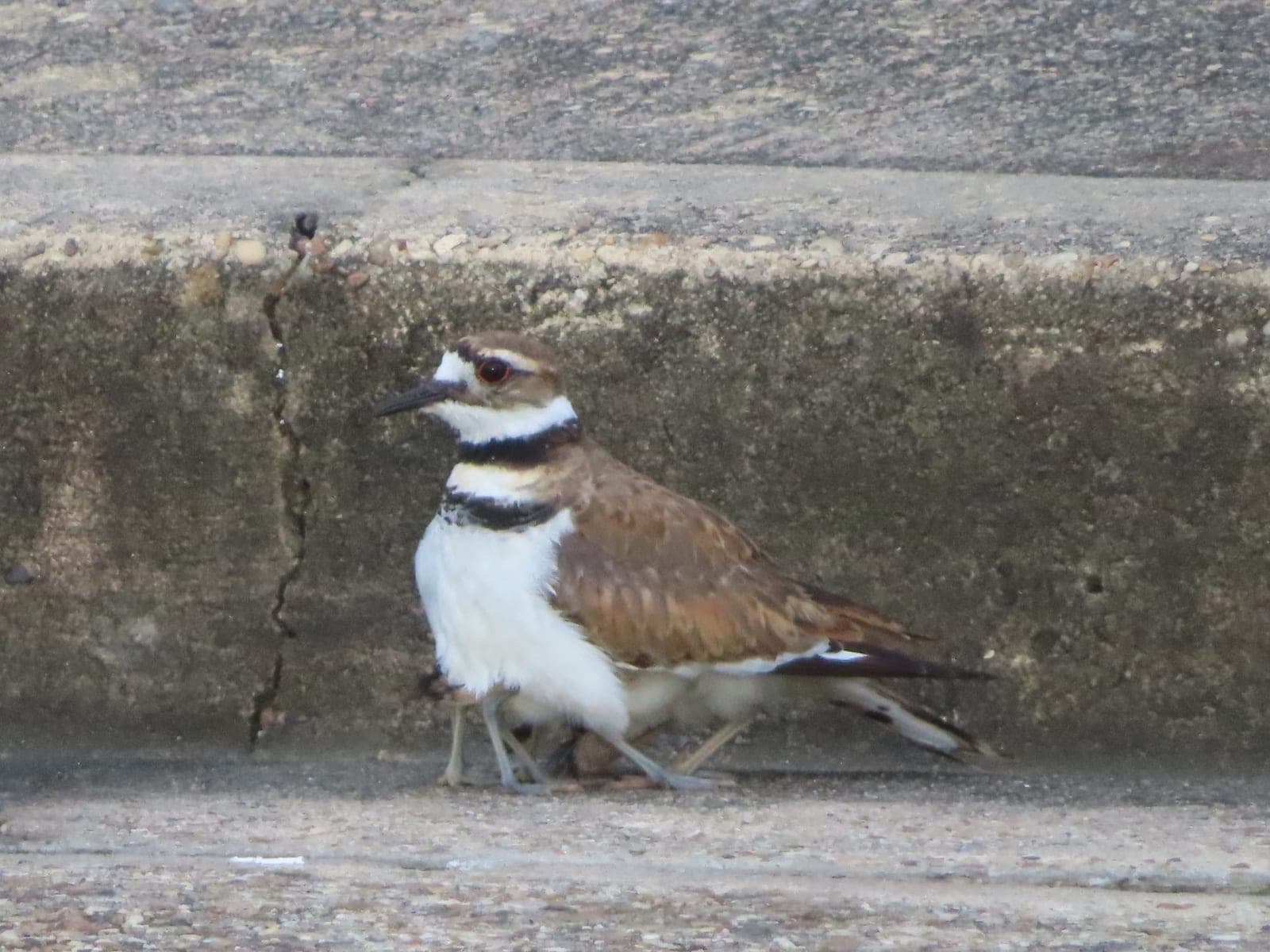
How to identify a killdeer
Killdeer are slender, robin-sized plovers with sandy-brown backs, white underparts and two bold black bands across the white breast; they are the only North American plover with two. The face is patterned in black, brown and white, the large dark eye is ringed in red-orange, and the bill is short and black. In flight, killdeer flash a bright orange-rufous rump and a long tail tipped in black and white, plus a white stripe along each wing. Downy chicks are balls of fluff on long legs and wear a single breast band. On the ground killdeer run in short bursts, stop dead, bob and run again, and they are rarely quiet for long.
- Two black bands across a white breast (chicks show one)
- Bright orange-rufous rump and tail in flight
- Red-orange ring around a large dark eye
- Shrill 'kill-deer' and 'dee-dee-dee' calls
- Runs, stops and pecks on bare ground or short grass
Look-alikes
Semipalmated Plover
Smaller and stubbier, with a single black breast band, a short orange bill tipped in black and orange-yellow legs. It is a bird of mudflats and beaches in migration rather than lawns and pastures.
Piping Plover
A pale, sand-colored beach plover with one narrow, often broken breast band and orange legs. It is federally listed as threatened or endangered depending on the population, so many nesting beaches are fenced off.
Wilson's Plover
A coastal plover of southern beaches with a single broad breast band and a heavy, all-black bill noticeably thicker than a killdeer's. It shows no orange rump in flight.
Range & habitat
Killdeer breed across most of North America, from parts of Alaska and much of Canada south through the lower 48 and Mexico into Central America, with separate resident populations in the Bahamas and Greater Antilles and along the coasts of Ecuador, Peru and northern Chile. Birds from the North migrate, while across much of the central and southern United States killdeer are present all year. Migrants winter across the southern states, Mexico and Central America.
Killdeer want open ground with short or no vegetation: pastures, plowed and stubble fields, sod farms, lawns, golf courses, athletic fields, gravel roads, parking lots, airports and flat gravel rooftops, as well as mudflats, lakeshores and river bars. They often nest well away from water but do best with shallow puddles or wet feeding spots nearby. In migration and winter they gather in loose flocks on fields and mudflats, and outside the breeding season they may feed at night under a bright moon.
Through the seasons
Spring
Killdeer are among the first migrants north, often back by late February or March, calling over still-brown fields. Pairs perform noisy display flights and scrape out nests; egg-laying runs from mid-March in the South to mid-July in the North.
Summer
Chicks scamper after their parents within hours of hatching, and parents put on broken-wing acts at the slightest threat. Pairs that lose a nest readily try again, and some in warm regions raise two broods. Northern birds start leaving breeding areas after mid-July.
Fall
Migration peaks in August and September, when flocks gather on sod farms, plowed fields, flooded fields and drawn-down reservoirs before moving south.
Winter
Killdeer winter across the southern half of the United States and south through Mexico and Central America, gathering on fields, mudflats and coastal wetlands. Some linger farther north wherever the ground stays open.
How to find and watch killdeer
Killdeer tend to find you: walk across an open field or gravel lot in spring and one will usually start calling. The skill is reading what its behavior is telling you and keeping clear of a nest you may not be able to see.
- Listen for shrill 'kill-deer' and rapid 'dee-dee-dee' calls over fields, ball diamonds and parking lots from late winter on.
- Scan bare dirt, gravel edges and short grass; the double breast band breaks up the bird's outline until it moves.
- If a killdeer drags a wing, fans its orange tail and cries pitifully, a nest or chicks are close: stop, watch where you step and retreat the way you came.
- Where a nest sits in a lot, lane or field edge, set a few cones or flags well back so mowers and vehicles avoid it for the roughly four weeks of incubation.
- In late summer and fall, check sod farms, flooded fields and reservoir mudflats for flocks.
- Never move a nest or 'rescue' chicks; the adults are nearby, and killdeer, nests and eggs are protected under the Migratory Bird Treaty Act.
Diet & life cycle
What it eats
Killdeer eat mostly invertebrates: beetles, grasshoppers, caterpillars, fly larvae, earthworms, spiders, centipedes, crayfish and snails, plus a few seeds. They hunt by sight, running a few steps, stopping to look and then jabbing at prey. They follow tractors to snap up exposed grubs and favor short-grass pastures with livestock and standing water.
Life cycle
The nest is a shallow scrape in open ground, often lined with white pebbles, shell bits or debris that may help keep the eggs cool. The female usually lays 4 buff eggs blotched with black and brown, and both parents incubate for 22 to 28 days, shading the eggs in hot weather and even soaking their belly feathers to cool them. Chicks are precocial: they leave the nest within a day, feed themselves while both parents guard them, and fly at about 25 to 31 days. Predators destroy more than half of nests, so pairs renest readily, and killdeer can breed at one year old.
Oldest on record
The oldest killdeer in the USGS Bird Banding Laboratory's longevity table was at least 10 years 10 months old. It was banded as a chick in Kansas in July 1963 and recaptured and released in Kansas in May 1974.
SourceAttracting & watching
Killdeer are one of the few shorebirds that come to people. Lawns, school fields, farm lanes and gravel driveways all draw them; open short grass, shallow puddles and unpaved gravel edges suit them, while feeders do not. The best watching is in early spring, when courting birds call and display overhead, and in late summer, when families and flocks feed on mudflats and wet fields. A nest in a busy spot is best left in place and watched from a distance, with traffic steered around it.
Conservation
Near Threatened (IUCN). Killdeer are still common and widespread, with Partners in Flight estimating about 2.3 million breeding birds, but they have been declining for decades: the Breeding Bird Survey shows a loss of roughly a quarter of the population from 1966 to 2019. In 2024 BirdLife International and the IUCN moved the species from Least Concern to Near Threatened because of an estimated decline of more than 20 percent over three generations. Nests on roads, lots and rooftops often fail, and chicks hatched on flat roofs can be trapped by parapets or die jumping down. Killdeer are protected under the Migratory Bird Treaty Act.