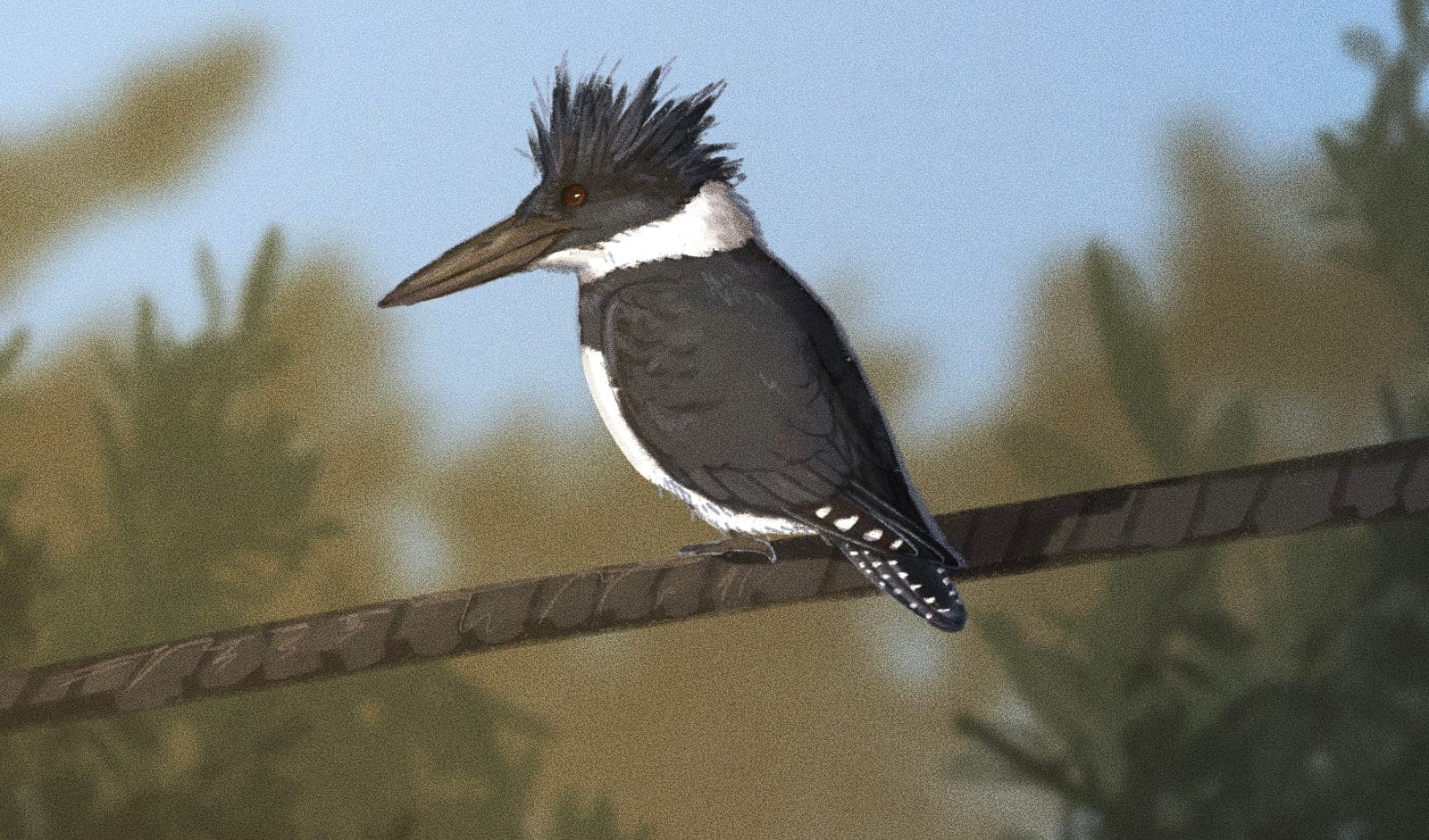
How to identify a belted kingfisher
Kingfishers are top-heavy birds, between a robin and a crow in size, with an oversized head, a ragged crest, a long, thick, daggerlike black bill, tiny feet and a short tail. The head and back are slate blue-gray, with a white spot in front of the eye and a broad white collar that nearly circles the neck. Males wear a single blue-gray band across the white breast. Females add a second, rusty-orange band across the belly that runs down the flanks, which makes them the more colorful sex. Juveniles show rusty spotting in the breast band. In flight, a kingfisher shows stiff, uneven wingbeats, a small white patch near the wingtip and the loud rattle it gives almost every time it moves.
- Blue-gray head and back with a shaggy crest
- Massive black bill on an oversized head
- White collar and a blue-gray breast band
- Females have an extra rusty band across the belly
- Loud, dry rattle as it flies along the water
Look-alikes
Blue Jay
Blue jays are bright blue with white wing bars and a black necklace, have a short bill, and live in woods and yards. A kingfisher is grayer-blue with a huge bill and white collar, and it rarely strays far from water.
Ringed Kingfisher
Found in the United States mainly in south Texas, the ringed kingfisher is much larger, with a heavier bill and a mostly rusty belly in both sexes.
Green Kingfisher
A sparrow-sized kingfisher of streams in south Texas, with a few in southeastern Arizona. It is dark green above rather than blue-gray, and far smaller than a belted kingfisher.
Range & habitat
Belted kingfishers breed across most of North America, from Alaska and most of Canada south through nearly all of the lower 48, wherever clear water with small fish meets banks to dig in. They stay as far north in winter as open water allows, including coastal southern Alaska, while northern birds that do migrate move to the southern states, Mexico, Central America, the West Indies and northern South America. Strays have turned up as far away as Hawaii, the Galápagos, Greenland, Iceland and Britain.
Kingfishers live along streams, rivers, ponds, lakes, estuaries and calm coastal bays with water clear enough to see prey near the surface and perches overhead: dead branches, power lines, bridge railings and dock posts. For nesting they need a vertical bank of sand, clay or soft earth, usually along water, but they also dig into road cuts, gravel pits and sand quarries some distance away. In winter almost any open water with small fish will do, from spring creeks to harbors and rocky coasts.
Through the seasons
Spring
Migrants return as soon as ice goes out, and pairs claim stretches of stream or shoreline with rattling chases. The male courts the female by bringing her fish, and the pair digs a fresh burrow or reopens an old one.
Summer
Adults shuttle fish to the burrow all day. Young leave the nest at about four weeks and are fed by their parents for roughly three more weeks while they learn to dive, so family groups are noisy and conspicuous in midsummer.
Fall
Young disperse, and northern birds move south along rivers, lakeshores and coasts as water cools and freezes. Migrants travel alone rather than in flocks, and some likely fly at night.
Winter
Kingfishers hold out wherever water stays open, from spring creeks and dam tailwaters in the northern states to the Alaska coast, and become more numerous across the South, Mexico and Central America.
How to find and watch belted kingfishers
Kingfishers announce themselves. Learn the rattle and you will find them on almost any clear stream, pond or lakeshore; the challenge is getting a look before the bird flies off down the bank.
- Listen for a loud, dry, mechanical rattle as a bird flies low along the water; it is often the first and only clue.
- Scan high perches over water: dead limbs, wires, bridge railings and dock pilings.
- Watch for a bird hovering on fast wingbeats over open water before folding into a headfirst plunge.
- In spring, look for round holes about 3 to 4 inches across near the top of steep dirt banks, road cuts and gravel pits.
- Keep moving slowly along the bank or drift past in a boat; stopping right under a perch or near a burrow usually sends the bird off.
- Stay off nesting banks and never probe burrows; kingfishers may abandon territories where people crowd them.
- Leave dead snags over your pond and keep earthen banks unarmored if you can; riprap and concrete remove nest sites.
Diet & life cycle
What it eats
Kingfishers eat mostly small fish caught near the surface, such as minnows, sticklebacks, young trout and mummichogs. They also take crayfish, frogs, tadpoles and aquatic insects, and now and then small mammals, young birds, lizards and berries. A kingfisher hunts from a perch or a hover, dives headfirst, carries its catch back to a branch and beats it against the wood before swallowing it headfirst. It coughs up the bones and scales as pellets.
Life cycle
Both members of a pair dig the burrow, loosening soil with their bills and kicking it out with their feet, until they have a tunnel usually 3 to 6 feet long that slopes upward to an unlined chamber, which keeps rainwater from pooling inside. The female lays 5 to 8 glossy white eggs. Both parents incubate for 22 to 24 days, the female usually at night and the male taking over in the early morning. Nestlings leave the burrow 27 to 29 days after hatching and are fed for about three more weeks. Most pairs raise one brood a year, though some southern pairs raise two.
Oldest on record
The oldest belted kingfisher in the USGS Bird Banding Laboratory's longevity table was a male banded as an adult in Maryland in March 2003 and recaptured and released there in September 2006, making him at least 5 years 3 months old. Few kingfishers are banded, so the record is a low bar rather than a true limit.
SourceAttracting & watching
Kingfishers do not use feeders, birdbaths or nest boxes, but a property with a stream, pond or lakeshore keeps them around when dead snags still hang over the water and eroding dirt banks are left in place rather than armored with rock. The best watching is from a canoe, kayak or streamside trail early in the morning, when birds fish actively. In spring and early summer nesting banks deserve a wide berth; a parent kept away from its tunnel cannot feed its young.
Conservation
Least Concern (IUCN). Belted kingfishers remain widespread, and Partners in Flight estimates about 1.8 million breeding birds, but the North American Breeding Bird Survey shows a decline of about 0.9 percent a year from 1966 to 2019, a cumulative loss of roughly 38 percent. They were once shot around streams and fish hatcheries; today the main pressures are lost nesting banks and disturbance during breeding. They are protected under the Migratory Bird Treaty Act.