How to identify a brown pelican
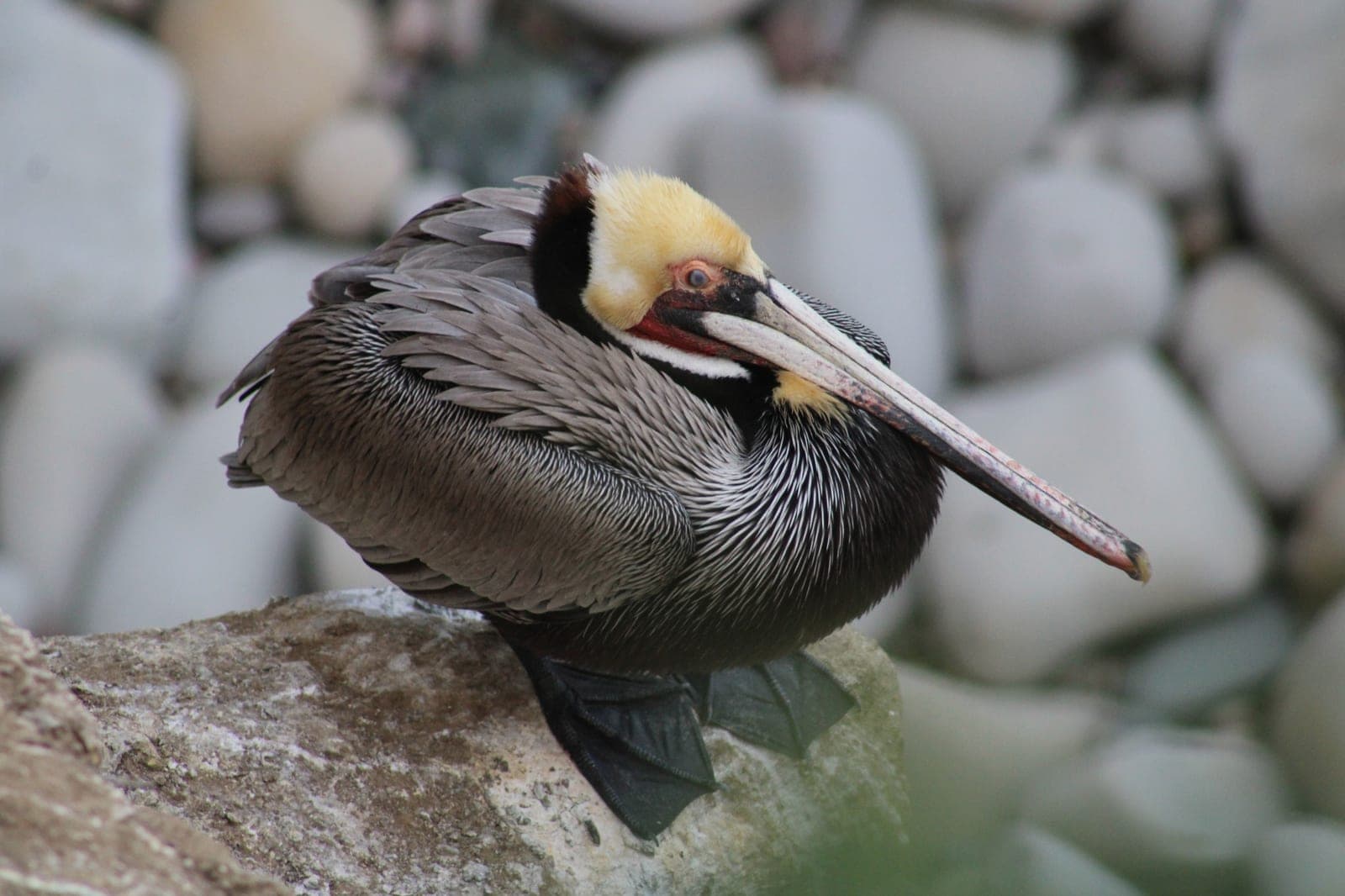
Brown pelicans are huge, heavy seabirds with a long neck, short legs and an enormous bill with a stretchy throat pouch. They are the smallest of the world's eight pelicans, yet still about the size of a great blue heron. Nonbreeding adults have a white head and neck with a yellowish wash on the crown, a silvery gray-brown back and a dark brown belly. In breeding season the back and sides of the neck turn deep chestnut, and the pouch becomes bright red in most Pacific birds but stays dark gray to olive on most Atlantic and Gulf birds. Immatures are plain gray-brown above with a whitish belly and take three to five years to reach adult plumage. Pelicans fly with the head drawn back onto the shoulders, alternating a few powerful flaps with long glides, often in lines low over the water.
- Huge bill and throat pouch on a gray-brown body
- White or yellowish head; chestnut hindneck in breeding season
- Plunges headfirst from the air to catch fish
- Flies in lines low over the waves, gliding between flaps
- Immatures plain brown above with a pale belly
Look-alikes
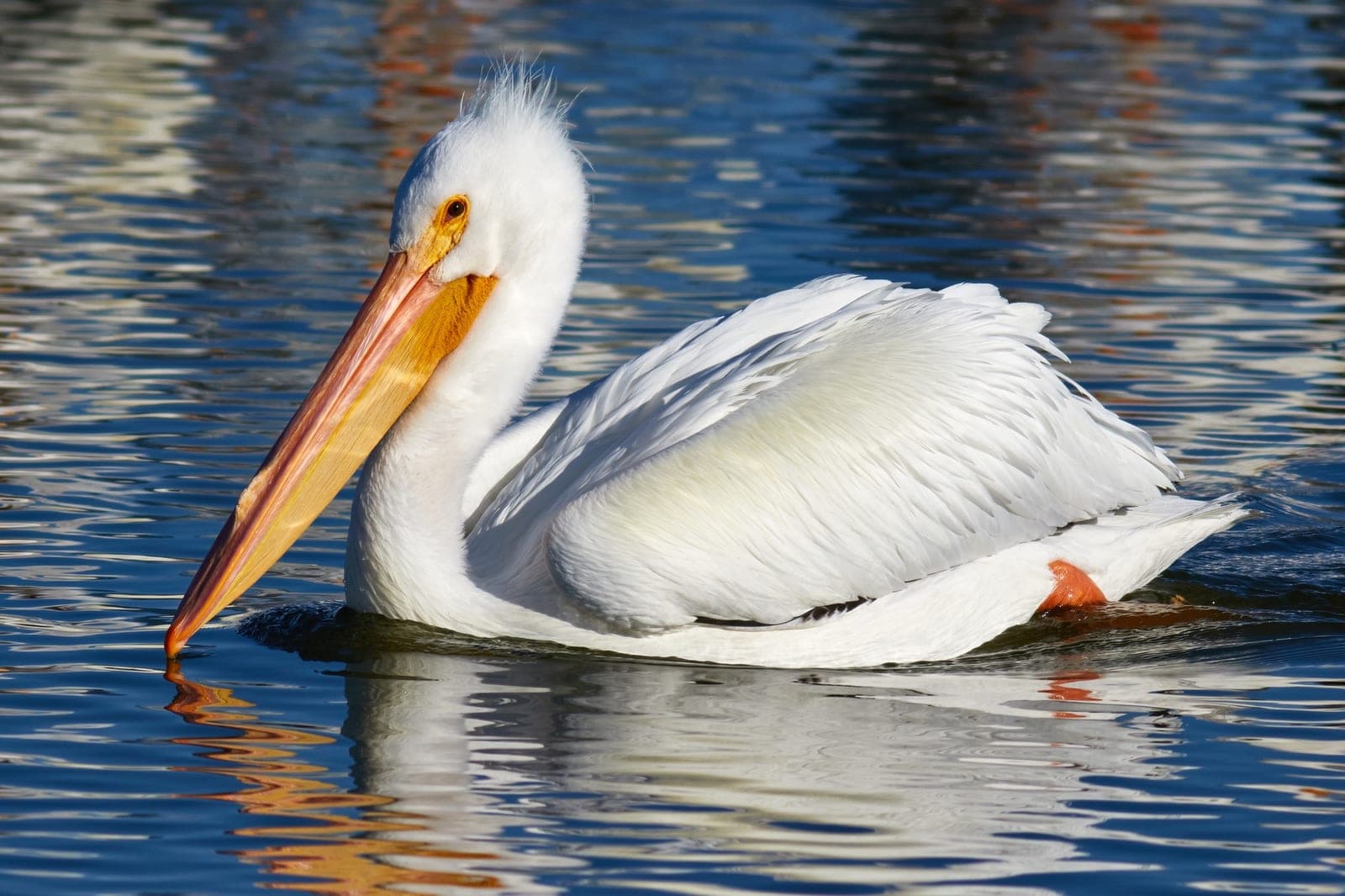
American White Pelican
White pelicans are bigger and mostly white, with black flight feathers and a bright orange-yellow bill. They swim and scoop fish instead of diving, and they nest inland.
Full comparison →Northern Gannet
Another plunge-diver of the Atlantic, but slimmer, with a pointed tail, a daggerlike bill and no pouch. Adults are white with black wingtips, and gannets usually fish farther offshore.
Range & habitat
Brown pelicans live along warm coasts of the Americas. On the Atlantic side they nest from about Maryland south through the Carolinas, Florida and the Gulf Coast to Texas, the Caribbean and northern South America. On the Pacific side they nest from southern California and Baja California through Mexico to Peru and the Galápagos. After nesting, flocks move north along both coasts, on the Pacific as far as Washington and British Columbia, before returning south for winter, and a few young birds wander inland, especially in the Southwest.
Brown pelicans are birds of salt water: shallow bays, estuaries, beaches, inlets, harbors and the nearshore ocean, rarely more than about 20 miles from land. They loaf on sandbars, pilings, jetties and fishing piers and nest on islands, from bare sand and rock to mangrove thickets, where raccoons and other ground predators cannot reach them. Freshwater lakes see them mostly as strays.
Through the seasons
Spring
Nesting times vary by region, and some Florida colonies are active in winter, but across most of the range spring is the heart of the season, when courting adults show chestnut necks and colonies fill with nest-building birds. Pacific birds gather at island colonies off southern California and Mexico.
Summer
Chicks grow from naked hatchlings to brown, flapping youngsters that leave ground nests at about five weeks. After nesting, Pacific pelicans spread north along the coast to Oregon, Washington and British Columbia, and Atlantic birds drift north as well.
Fall
Northern visitors on both coasts begin heading back south. Gray-brown juveniles, now flying well, are common around harbors and piers as they learn to dive.
Winter
Pelicans concentrate in warmer southern waters, from the Carolinas, Florida and the Gulf to California and Mexico, where they follow schools of baitfish and gather around fishing boats and docks.
How to find and watch brown pelicans
Brown pelicans are easy to find on almost any southern or Californian beach, pier or harbor. The highlight is the plunge dive, best watched where schools of baitfish push close to shore.
- Watch for lines of pelicans gliding just above the surf, rising and falling with the waves.
- Look for birds circling 20 to 60 feet up, then folding their wings for a headfirst dive, a sign that baitfish are near.
- Check fishing piers, jetties, marinas and bridge pilings, where pelicans rest close to people.
- Visit Pelican Island National Wildlife Refuge in Florida, the first national wildlife refuge, set aside by Theodore Roosevelt in 1903.
- Don't feed pelicans or toss them fish scraps; birds that learn to beg end up swallowing hooks and tangling in line.
- If a pelican takes your bait, reel it in gently rather than cutting the line, then remove the hook and line or call a local wildlife rescue.
- Stay off nesting islands, which are often posted and closed during the breeding season.
Diet & life cycle
What it eats
Brown pelicans eat almost nothing but fish, mostly schooling species near the surface such as menhaden, anchovies, sardines and smelt, plus some shrimp and other crustaceans. A pelican plunges from as high as about 60 feet, hits the water bill-first and scoops fish and water into its pouch, then tilts its bill to drain the water before tossing its head back to swallow. Gulls sometimes hover beside or even land on a surfacing pelican to snatch fish from the pouch.
Life cycle
Brown pelicans nest in colonies on islands, either on the ground in a scrape rimmed with sticks and debris or in stick nests in low trees and mangroves; the male brings material and the female builds. The female lays 2 to 3 white eggs, and both parents incubate for about 28 to 30 days. Chicks hatch naked, grow dark down within two weeks, and leave ground nests at about five weeks, while tree-nesting young may stay up to nine weeks. They first fly at around 9 to 12 weeks, are fed by their parents for a while after leaving the colony, and take three to five years to reach adult plumage and breed.
Oldest on record
The oldest brown pelican in the USGS Bird Banding Laboratory's longevity table was at least 27 years 10 months old. It was banded as a chick in South Carolina in June 1972 and caught and released in Florida in April 2000.
SourceAttracting & watching
Brown pelicans do not come to yards, but they are among the most watchable birds on the coast. Fishing piers, jetties, inlets and harbors give close views all year in Florida and along the Gulf, and from summer into fall along the Pacific Coast as far north as Washington. Colonies sit on islands that are often posted and closed in nesting season; boats that keep well off avoid flushing adults, which leaves eggs and chicks exposed to heat and gulls. Tossing fish scraps teaches pelicans to crowd piers, where they swallow hooks and tangle in monofilament.
Conservation
Least Concern (IUCN). DDT thinned brown pelican eggshells until they broke during incubation, and by 1963 the species had vanished from Louisiana and declined sharply elsewhere; it was declared endangered in 1970. After DDT was banned in 1972, and with a Louisiana program that moved young pelicans from Florida starting in 1968, populations rebounded. Atlantic Coast, Florida and Alabama birds were delisted in 1985 and the rest in 2009, when the U.S. Fish and Wildlife Service counted more than 650,000 brown pelicans across their range. Fishing line and hooks, oil spills such as Deepwater Horizon in 2010, and swings in sardine and anchovy stocks remain threats, and the species is still protected by the Migratory Bird Treaty Act.