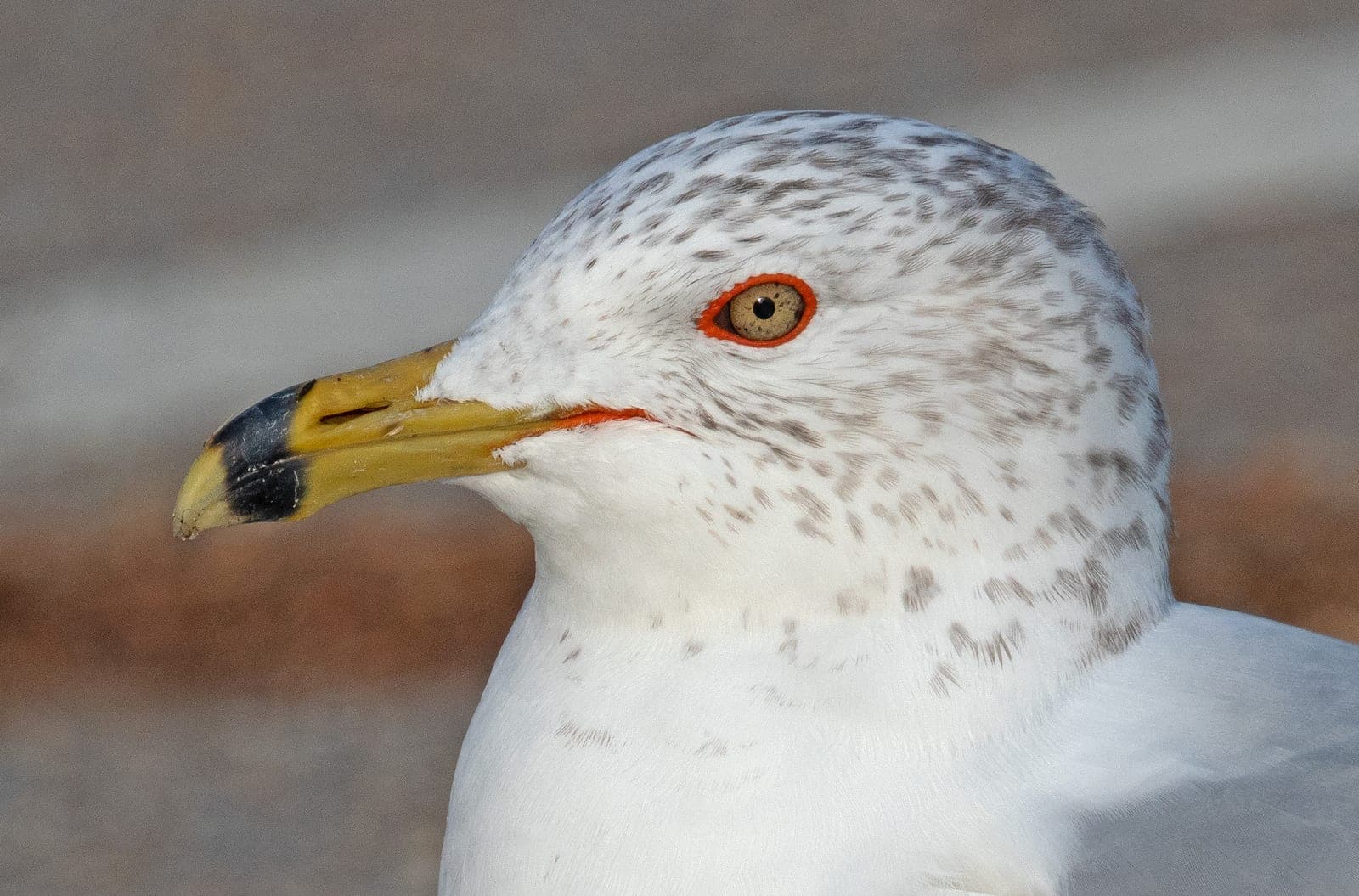
How to identify a ring-billed gull
Adults are white with pale silver-gray backs and wings, black wingtips with small white spots called mirrors, yellow legs, pale yellow eyes and a yellow bill crossed near the tip by a crisp black ring. In winter the head is flecked with brown. Ring-bills take about three years to reach adult plumage. Juveniles are mottled brown and gray with a pink bill tipped in black and pinkish legs; second-year birds have gray backs but more black in the wings and a dark tail band. Ring-billed gulls are medium-sized, clearly smaller and daintier than herring gulls, with a rounder head, a thinner bill and a more buoyant flight.
- Yellow bill with a complete black ring near the tip (adults)
- Yellow legs and pale yellow eyes
- Pale gray back; black wingtips with small white spots
- Medium size, clearly smaller than a herring gull
- Young birds have a pink, black-tipped bill and mottled plumage
Look-alikes
Herring Gull
Bigger and heavier, with pink legs and a thicker bill marked with a red spot near the tip of the lower mandible. Some winter herring gulls show a dusky smudge on the bill, so leg color and size are the safer checks.
California Gull
A western gull, slightly larger and darker gray-backed, with a dark eye, greenish-yellow legs and both red and black marks near the bill tip.
Short-billed Gull
Formerly lumped as the mew gull. Smaller and gentler-looking, with a short, plain yellow bill, a dark eye and a slightly darker gray back; it is mostly a Pacific Coast bird.
Range & habitat
Ring-billed gulls breed across the southern half of Canada and the northern United States: around the Great Lakes and the St. Lawrence, on the northern prairies, in the interior Northwest and Great Basin, and in smaller numbers on the Atlantic coast of Canada. In winter they spread across most of the United States, along the Pacific, Atlantic and Gulf coasts and into Mexico, while some stay as far north as open water lasts on the Great Lakes and in the mildest corners of Canada. They are regular visitors to Western Europe.
Ring-bills use fresh water as readily as salt: big lakes, reservoirs, rivers, harbors, beaches and estuaries, but also landfills, parking lots, city parks, sports fields and freshly plowed farmland, often miles from water. They are rarely seen far offshore. They nest in dense colonies on low, sparsely vegetated islands, breakwaters and spoil islands, and increasingly on flat industrial rooftops. In winter, big flocks roost on open water or ice at night and fan out to feed by day.
Through the seasons
Spring
Adults head north early and settle into breeding colonies on islands, breakwaters and rooftops, where thousands of pairs may nest together. Plowing season draws flocks to fields to snap up exposed worms and grubs.
Summer
Eggs hatch after about three and a half to four weeks, and chicks can fly at about five weeks. As colonies break up in late summer, brown juveniles show up on beaches, docks and parking lots across the North.
Fall
Flocks move south along coastlines and big river systems, flying higher over land. Plowed fields, landfills and lakeshores draw large gatherings during migration.
Winter
Ring-bills winter across the central and southern United States and along all three coasts, and many stay on the Great Lakes while open water lasts. Winter is the season for sorting ages and picking other gull species out of mixed flocks.
How to find and watch ring-billed gulls
Finding a ring-billed gull is rarely the problem. The fun is learning to pick one out of a mixed flock and tell its age, and a parking lot or beach flock gives close, easy practice.
- Start with the bill: a clean black ring on a yellow bill marks an adult ring-bill.
- Check the legs next, yellow on a ring-bill and pink on a herring gull.
- Age birds by how much brown they show: brown juveniles, gray-backed second-year birds with black tails, then clean adults by the third winter.
- Scan winter flocks at harbors, reservoirs and dam tailwaters for less common gulls mixed in.
- Read any metal or colored leg bands with binoculars and report them at reportband.gov; band reports are how longevity records like this species' are made.
- Skip the bread and fries; feeding gulls draws noisy, aggressive crowds and fouls beaches and parking lots.
Diet & life cycle
What it eats
Ring-billed gulls eat nearly anything: insects, earthworms and grubs turned up by plows, small fish, grain, rodents, eggs, and garbage and fast-food scraps. They walk, wade, swim and hover to find food, pick it from the surface, scavenge at landfills and steal from other birds. Landfills and farm fields provide such a reliable food supply that they helped fuel the species' population growth in the 20th century.
Life cycle
Ring-billed gulls nest in colonies on the ground, building a shallow cup of grasses, twigs and moss among sparse plants or bare rock. The female usually lays 2 to 4 gray to olive eggs blotched with brown; clutches larger than four usually mean two females are sharing one nest. Both adults incubate for 23 to 28 days. Young can fly at about five weeks and become independent five to ten days later. It takes about three years for a ring-billed gull to grow into adult plumage.
Oldest on record
The oldest ring-billed gull in the USGS Bird Banding Laboratory's longevity table was at least 31 years 6 months old. It was banded as a chick in Ontario in June 1992, and its federal band was read on the living bird in Ohio in December 2023.
SourceAttracting & watching
Ring-billed gulls come to people without any help, so attracting them is never the goal. The best watching is at beaches, harbors, piers, reservoirs and dam tailwaters in winter, when large mixed flocks gather and different ages and species stand side by side, and on spring and fall fields behind plows. Feeding gulls trains them to mob people and concentrates droppings. Breeding colonies on islands and breakwaters are best viewed from a distance; adults dive at intruders, and trampled nests fail.
Conservation
Least Concern (IUCN). Hunted for their feathers and pushed from their nesting grounds, ring-billed gulls were seriously depleted by the late 1800s. Legal protection, and abundant food from landfills and farms, fueled a strong comeback: the eastern North American breeding population peaked around 1990 at roughly 875,000 pairs and has eased slightly since, partly as landfills were covered. The total population still runs into the millions. Where ring-bills crowd airports, rooftops or tern colonies, managers sometimes act to move them, and the species remains protected under the Migratory Bird Treaty Act.