How to identify a great egret
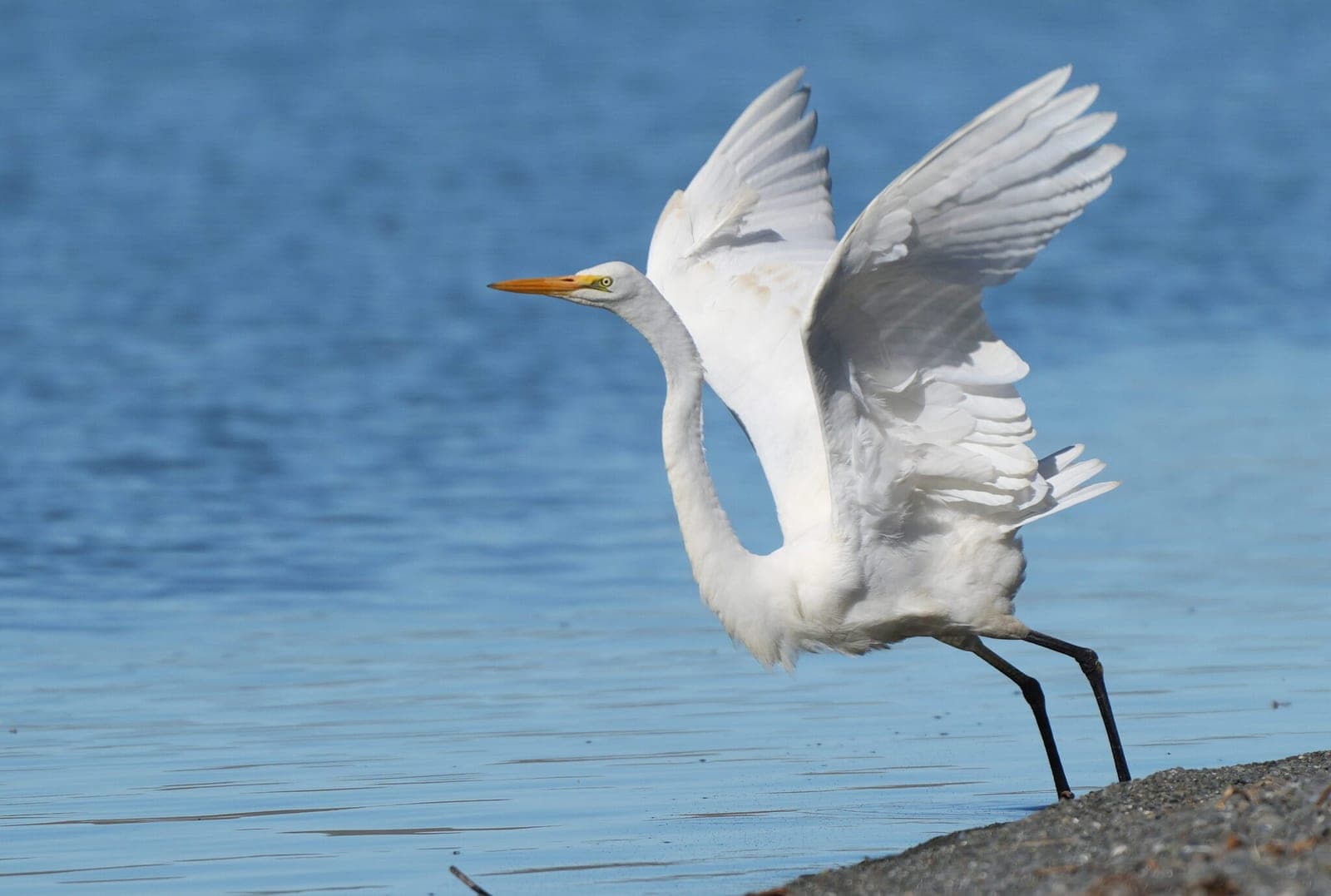
Great egrets are large, slender, entirely white herons with a long, kinked neck, a stout yellow to yellow-orange bill, and black legs and feet. In breeding season adults grow long, lacy plumes, called aigrettes, that trail from the back past the tail, and the bare skin between the eye and the bill turns bright lime green. The corner of the mouth extends back beyond the eye, a fine point that separates it from smaller white herons. In flight the neck tucks back into an S, the black legs trail well past the tail, and the broad white wings beat slowly and steadily. Young birds look like adults without plumes. Away from colonies egrets are mostly quiet, but a flushed bird gives a low, guttural croak.
- Large, long-necked heron that is white from head to tail
- Thick yellow bill; lime-green skin in front of the eye when breeding
- Black legs and black feet
- Long, lacy back plumes in breeding season
- Slow wingbeats with neck folded and legs trailing
Look-alikes
Snowy Egret
Noticeably smaller and daintier, with a slim black bill, black legs and bright yellow feet. Snowy egrets often dash and shuffle after prey, while great egrets wade slowly or stand still.
Cattle Egret
Much smaller and stockier, with a short neck and a short yellow bill, often walking in pastures beside livestock. Breeding birds show buff-orange on the head, chest and back.
Great Blue Heron (white form)
South Florida's great white heron is a white form of the great blue heron. It is bulkier, with a heavier bill and pale yellowish legs instead of the egret's black ones.
Full comparison →Little Blue Heron (young)
First-year little blue herons are white too, but they are much smaller, with a bluish-gray bill tipped in black and dull greenish legs.
Range & habitat
Great egrets breed across the eastern United States north to the Great Lakes, southern Ontario and New England, through Florida and along the Gulf Coast, and in the West mainly in California and at scattered interior wetlands; the range continues through Mexico and Central America into South America. They are most abundant in the Southeast, and the breeding range has been creeping north for decades. After nesting, many wander north in late summer, then pull back in fall to places where water stays open: the southern states, the Pacific Coast, Mexico and the Caribbean.
Great egrets use almost any shallow, open water with fish, fresh or salt: marshes, swamps, pond and lake edges, tidal flats, estuaries, lagoons, wooded rivers, flooded fields, ditches and stormwater ponds in suburbs. They often feed in loose groups with other herons and cormorants, and they also stalk dry fields for grasshoppers and rodents. Colonies sit in trees or shrubs near or over water, often on islands or in swamps, usually mixed with other herons, ibises, cormorants and anhingas, with egrets tending to take the higher nests.
Through the seasons
Spring
Adults grow breeding plumes and green facial skin and gather at colonies, earlier in the South than in the North. Males claim a nest site and court females with calls, circling display flights and exaggerated neck stretches, so spring is the season to see egrets at their showiest.
Summer
Colonies fill with croaking adults and squabbling chicks. Once young can fly, adults and juveniles scatter widely, and late summer brings egrets to ponds, reservoirs and marshes well north of where they nest.
Fall
Northern birds drift south through September and October, often streaming into communal tree roosts at dusk. Lingering birds stay on northern marshes until ice and cold push them out.
Winter
Great egrets winter wherever water stays open: across the southern states, along the Atlantic, Gulf and Pacific coasts, and south into Mexico and the Caribbean. Southern marshes and refuges hold residents and northern visitors together.
How to find and watch great egrets
White plumage makes great egrets one of the easiest wading birds to spot, often from half a mile away. The work is finding the shallow, fish-rich water they need in the right season, and watching without pushing them off it.
- Scan marsh edges, retention ponds, flooded fields and tidal flats from levees, causeways and refuge auto-tour roads; look for white dots against green or brown.
- Go in spring to see breeding plumes and lime-green faces, when courting birds stretch their necks and fan their aigrettes.
- Visit colonies that are set up for viewing, such as the rookery at the St. Augustine Alligator Farm in Florida, where wild egrets, herons, wood storks and spoonbills nest within easy camera range.
- In late summer, check northern ponds, reservoirs and river backwaters for wandering egrets far from any colony.
- At sunset, watch for egrets flying to communal roosts in trees over water.
- Keep well back from colonies in the wild and leave if adults flush from nests; exposed eggs and chicks are quickly taken by crows and other predators.
Diet & life cycle
What it eats
Great egrets eat mostly fish, plus crayfish, shrimp, frogs, salamanders, snakes and aquatic insects. In fields they catch grasshoppers, mice and voles, and they occasionally take small birds such as rails. They hunt by standing still or wading slowly, then striking with a fast jab of the bill, and they sometimes follow cattle, feed alongside cormorants that flush fish, or steal food from smaller herons.
Life cycle
Great egrets usually begin breeding at two or three years old. Both sexes build a platform of sticks, typically 10 to 40 feet above ground or water, and the female lays 3 to 4 pale blue-green eggs. Both parents incubate for 23 to 26 days and feed the chicks by regurgitation. Chicks clamber out of the nest onto branches at about three weeks and can fly at six to seven weeks. The eggs hatch a day or more apart, and the older chicks often bully the youngest, which may starve when food is short.
Oldest on record
The oldest great egret in the USGS Bird Banding Laboratory's longevity table was at least 22 years 10 months old. It was banded as a nestling in Ohio in June 1947 and recovered in Ohio in April 1970.
SourceAttracting & watching
Egrets do not visit feeders, but they readily use urban and suburban water such as park lakes, golf course ponds, stormwater basins and marsh boardwalks, where they often allow close views. National wildlife refuges with levee roads and auto tours are reliable year-round in the South and from spring through fall farther north. Nesting colonies are spectacular in spring but sensitive; distance, binoculars and a long lens keep adults on their eggs.
Conservation
Least Concern (IUCN). Plume hunters shot great egrets at their nesting colonies in the late 1800s, leaving chicks to starve, and nearly eliminated the species from the United States. Public outrage led to state plumage laws and the Migratory Bird Treaty Act of 1918, and protected colonies recovered quickly. The Breeding Bird Survey shows North American numbers rising by about 1.5 percent a year from 1966 to 2019 as the range pushed north, though wetland loss has hurt some southern colonies.