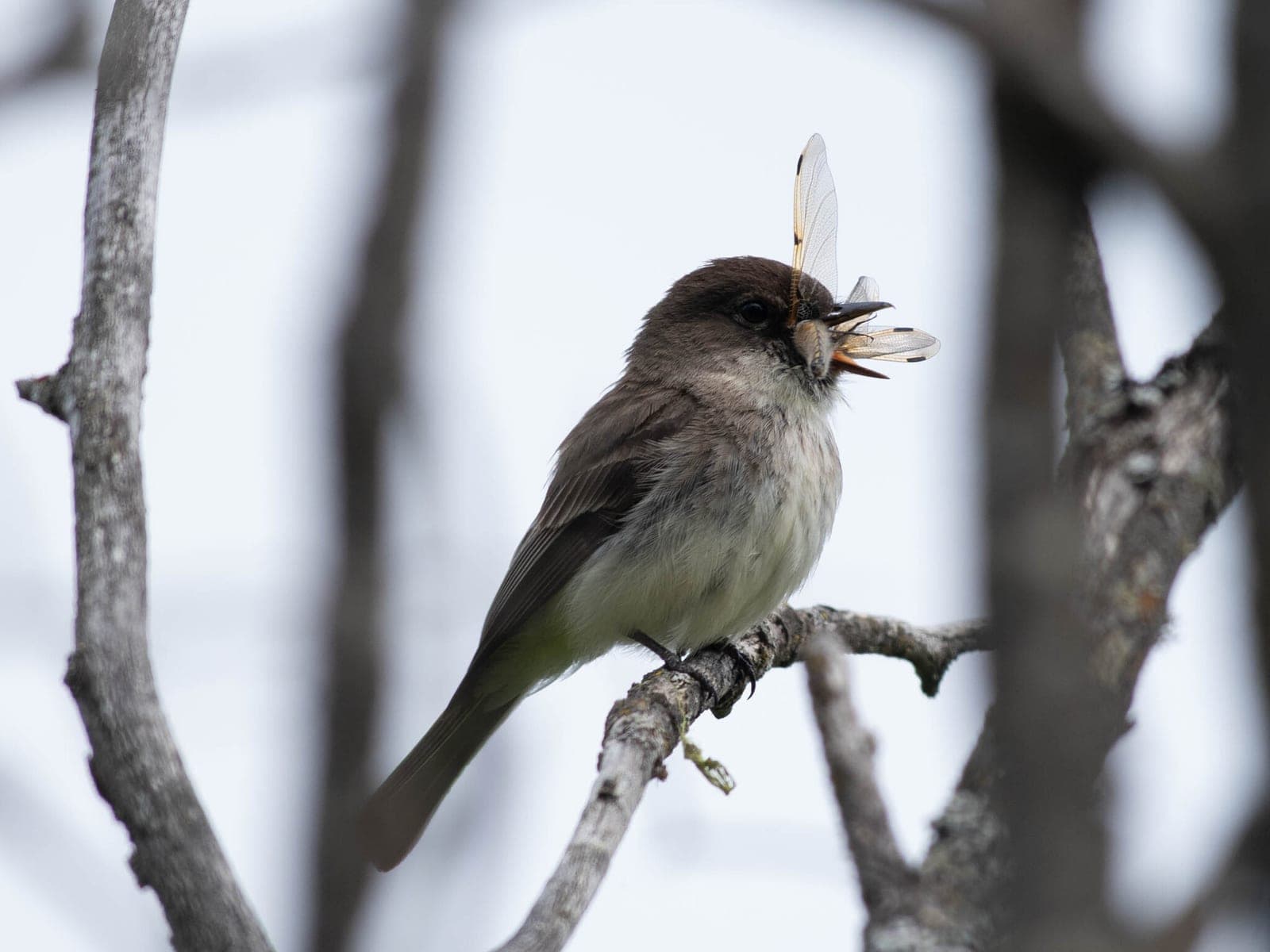
How to identify a eastern phoebe
Eastern Phoebes are stocky, big-headed flycatchers about the size of a sparrow, gray-brown above with a darker, sooty head and an off-white throat and underparts. The contrast between the dark head and pale throat is a good mark. There is no eyering and the bill is all dark, and the wings show only faint, buffy bars, if any. In fresh fall plumage the belly takes on a pale yellow wash. The real clincher is behavior: a perched phoebe pumps and spreads its tail over and over, and it sings a two-note 'fee-bee' over and over, with a short, sharp 'chip' call. Phoebes hunt from low, open perches, flying out to snap up passing insects.
- Constant tail-wagging while perched
- Dark, sooty head contrasting with a pale throat
- No eyering and no bold wing bars
- All-dark, flat flycatcher bill
- Song a two-note 'fee-bee', repeated many times
Look-alikes
Eastern Wood-Pewee
Pewees have crisp pale wing bars, longer wings, a pale lower bill and no tail-wagging. They arrive much later in spring and sing a slurred 'pee-a-wee.'
Least Flycatcher
Leasts are smaller, with a bold white eyering and white wing bars, and they sing a snappy 'che-bek.' Phoebes have no eyering, faint wing bars and the slow, wagging tail.
Say's Phoebe
The western phoebe of open, dry country. It also wags its tail, but it has a cinnamon-orange belly and grayish-brown upperparts, and it rarely strays into the East.
Range & habitat
Eastern Phoebes breed across much of central and eastern North America, from northeastern British Columbia and the southern Northwest Territories east to New Brunswick, and south to roughly central Texas and Georgia. Planting of trees and fire suppression on the Great Plains helped the species push west in the last century. They winter in the southern United States, from the mid-Atlantic coast through Florida and the Gulf states, and in Mexico, with some in Cuba.
In the breeding season phoebes stay near water in woodland or semi-open country: streamsides, farmyards, wooded ravines and country roads with bridges and culverts. Natural nest sites are rock ledges and streambanks with an overhang, but most now use buildings, bridges, culverts and porches. In winter they live along wooded edges, brushy areas and streams, often near water.
Through the seasons
Spring
Phoebes are among the earliest returning migrants. Nesting starts in mid to late March in the southern states and around mid to late April in the North and southern Canada, and males come back about two weeks before females.
Summer
Pairs usually raise two broods, often reusing the same ledge or building on top of an old nest. Watch for adults sallying out from a low perch near the nest and returning with insects.
Fall
Phoebes leave late compared with other flycatchers, mostly in September and early October. They eat more berries as insects fade, and their fresh plumage shows a soft yellow wash on the belly.
Winter
They winter from the mid-Atlantic and Gulf states into Mexico, where small fruits and berries become an important part of the diet during cold spells.
How to find and attract Eastern Phoebes
Phoebes come readily to human structures, so the best places to look are bridges over streams, barns, sheds and porches near water. Listen for 'fee-bee' early in spring, then watch for a small gray bird wagging its tail on a low branch or railing.
- Check under bridges and inside culverts over small streams for mud-and-moss nests on ledges and beams.
- Listen for the burry 'fee-bee' on cool March and April mornings, before most other migrants arrive.
- Watch low, open perches near water for a bird that keeps pumping its tail.
- Put up a nest platform on a building 3 to 16 feet up, close to an overhang, with fresh water nearby.
- Leave existing phoebe nests in place; pairs often reuse the same site year after year.
- Plant native fruiting shrubs; phoebes eat berries during cold spells in fall and winter.
- Keep cats indoors; phoebes often feed and nest low and close to houses.
Diet & life cycle
What it eats
Insects make up most of the phoebe's diet, especially in summer. It waits on a perch, flies out to catch wasps, bees, flies, beetles, true bugs, grasshoppers and other insects in midair, sometimes hovers to pick prey off leaves, and drops to the ground for crawling prey. It also eats spiders, ticks and millipedes, and small fruits and berries become important in the cooler months.
Life cycle
Males sing hardest at dawn to hold territories, and an occasional male has two mates. The female builds an open cup with a solid base of mud, built up with moss, leaves and grass and lined with fine grass and hair, on a ledge with shelter above. She lays four or five eggs, sometimes two to six, white and sometimes faintly dotted, and incubates them for about 16 days. Both parents feed the nestlings, which leave the nest about 16 days after hatching. Most pairs raise two broods a year, and Brown-headed Cowbirds sometimes lay in their nests.
Oldest on record
The oldest Eastern Phoebe in the USGS Bird Banding Laboratory longevity table was at least 10 years and 4 months old. It was banded in Iowa in October 1979 in its first fall and was found in Alberta in October 1989, killed by a cat.
SourceAttracting & watching
Phoebes ignore seed feeders, but a nest platform under an eave or overhang near water, an undisturbed bridge or shed ledge and native berry-bearing shrubs make a property phoebe-friendly. Watch for them along streams, farm lanes and lake cabins from early spring through October. Keep cats indoors, since phoebes hunt close to the ground near houses. They are protected under the Migratory Bird Treaty Act.
Conservation
Least Concern (IUCN). Eastern Phoebes probably increased as bridges and buildings created new nest sites, and the Breeding Bird Survey shows numbers rising slightly from 1966 to 2019. Partners in Flight estimates about 35 million birds, and the species is of low conservation concern, though trends vary from region to region.