Game animals · Side by side
Elk vs Moose
How to tell them apart
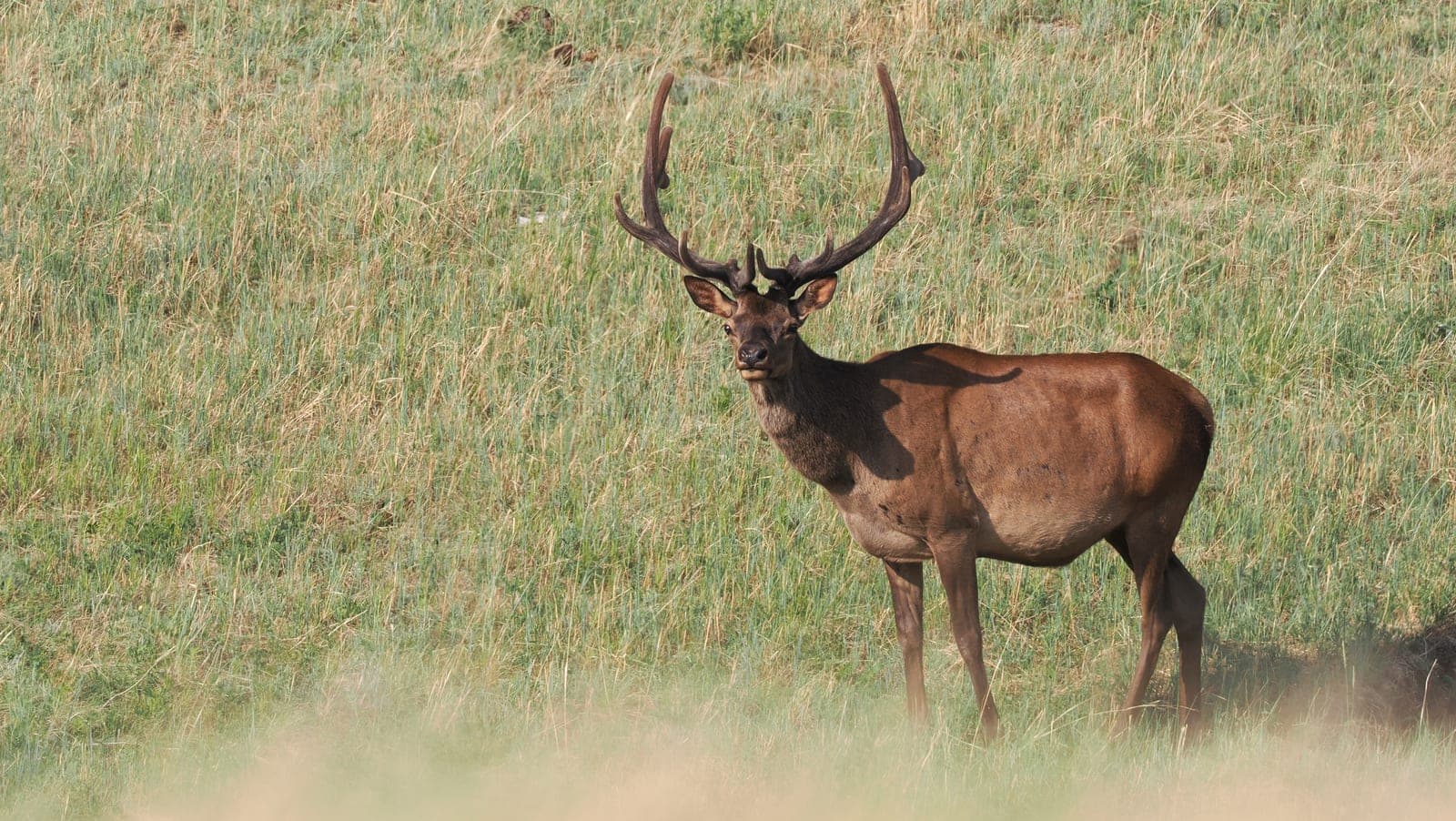
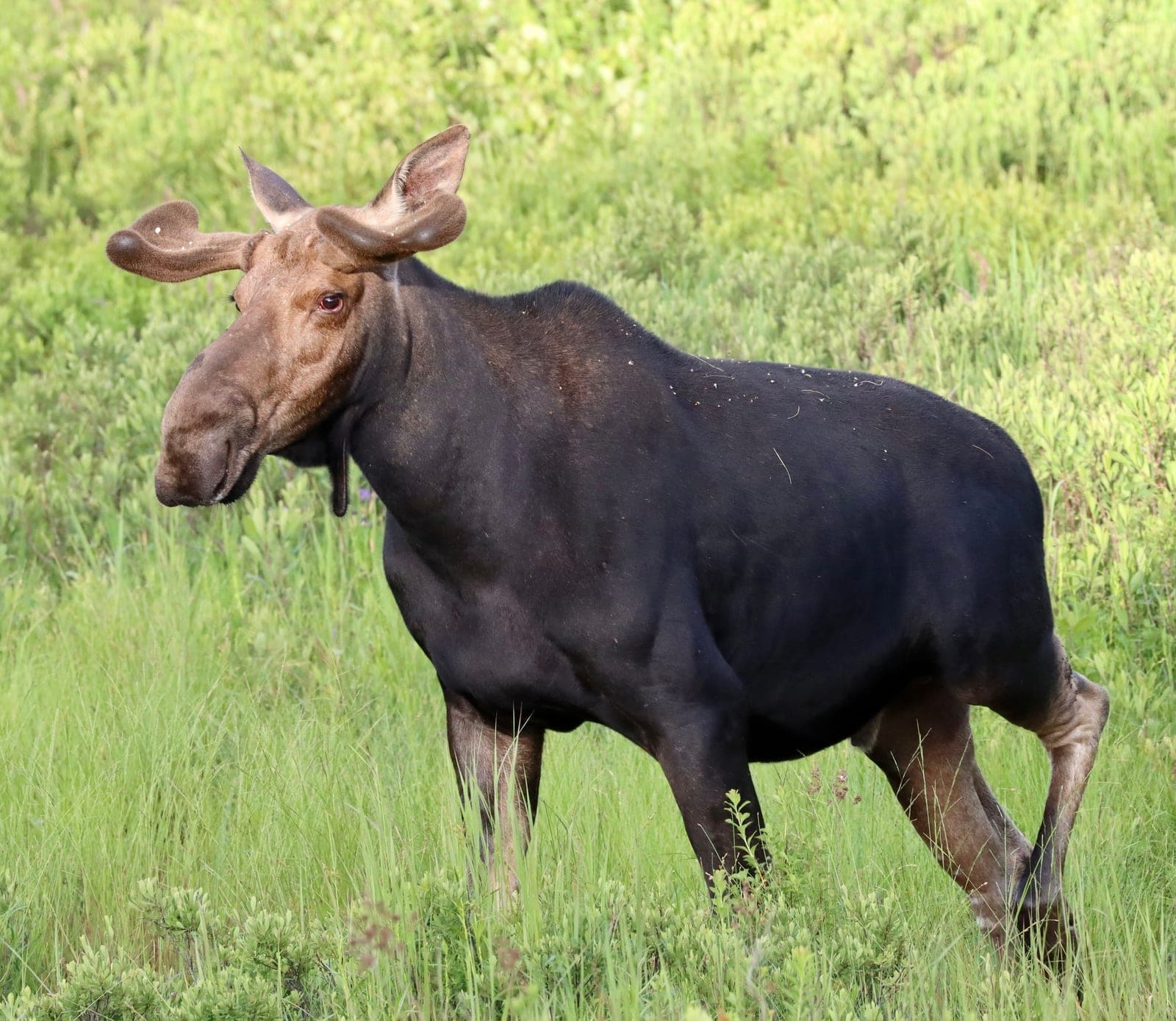
Quick answer
Check color and antlers: an elk is tan with a dark brown neck and a pale rump patch, and bulls carry branching antlers that sweep back; a moose is dark brown to black, with a long, drooping nose, a bell of skin under the chin and, on bulls, broad, flat antlers.
Elk and moose are the two biggest deer in North America, and they share mountain valleys across the northern Rockies and western Canada. The names cause half the confusion, because in Europe the word 'elk' means the moose. In the field the two look nothing alike once you know what to check, and the difference matters for tags, seasons and safety.
Key differences
| Trait | Elk | Moose |
|---|---|---|
| Size | Bulls about 700 lb, about 5 ft at the shoulder | Bulls about 1,000–1,600 lb, up to about 6.5 ft |
| Color | Tan body, dark brown neck and legs, buff rump patch | Dark brown to black, with pale gray lower legs |
| Antlers | Long, round beams with tines, sweeping back | Broad, flat palms edged with points |
| Face | Typical deer head and muzzle | Long, overhanging nose and a dewlap, or bell |
| Social life | Herds, sometimes in the hundreds | Solitary or in small family groups |
| Rut sounds | Bulls bugle; cows mew and chirp | Bulls grunt; cows give long, nasal moans |
| Food | Mainly a grazer of grasses and sedges | A browser of willow, birch, aspen and pond plants |
| Habitat | Meadows, open timber, foothills and sagebrush | Willow bottoms, wetlands and boreal forest |
Why Europeans call a moose an elk
In Britain and the rest of Europe, 'elk' has long meant Alces alces, the animal North Americans call a moose. When English-speaking settlers met both animals in North America, they gave the old name to the wapiti, Cervus canadensis, and borrowed 'moose' from an Algonquian language for the bigger deer. The result is a mix-up that still trips up travelers and translators: a Swedish or Norwegian 'elk' hunt is a moose hunt.
Where they overlap
Elk and moose share ground across the northern Rockies of Montana, Idaho, Wyoming, Utah and Colorado, in Yellowstone, and through Alberta and British Columbia. Even where both live, they split the habitat: elk feed in open meadows and parks and bed in timber, while moose stay close to willow flats, beaver ponds and river bottoms. Moose also range far across the boreal forest of Canada, Alaska and the northeastern United States, where elk are absent or rare.
Hunting and eating each
Elk are hunted across the West, with general tags in some states and limited-draw units in others, and most hunts involve covering ground and calling during the September rut. Moose tags in the lower 48 are usually limited draws with low odds, while Alaska and Canada offer far more opportunity, often by boat or canoe. Both make excellent table fare: elk is mild and fine-grained, moose is lean and beef-like, and a bull of either species produces a huge amount of meat to pack out.
By the numbers
The traits the daily hunt game compares for each.
| Clue | Elk | Moose |
|---|---|---|
| Type | Big game | Big game |
| Habitat | Mountains | Wetlands |
| Headgear | Antlers | Antlers |
| Region | Western mountains | Northern forests |
| Typical weight | 710 lb | 1,200 lb |
| Diet | Herbivore | Herbivore |
FAQ
Is a moose bigger than an elk?
Yes, by a wide margin. A big Alaska bull moose can weigh 1,600 pounds, roughly twice a typical Rocky Mountain bull elk, and stand well over six feet at the shoulder.
What do Europeans call the North American elk?
Usually wapiti, from a Shawnee and Cree word meaning 'white rump'. Its closest European relative is the red deer, while the European 'elk' is the moose.
Can an elk and a moose breed?
No. Elk belong to the genus Cervus and moose to Alces, and the two are too distantly related to produce hybrids.
Which is more dangerous, an elk or a moose?
Both deserve space, but moose are involved in more attacks on people, especially cows with calves and rutting bulls. Elk can also charge during the rut and calving season, which is why Yellowstone requires visitors to stay at least 25 yards from both elk and bison.
Could you tell them apart from a few clues? Test yourself in today's puzzle.
Play the daily hunt game