How to identify a great blue heron
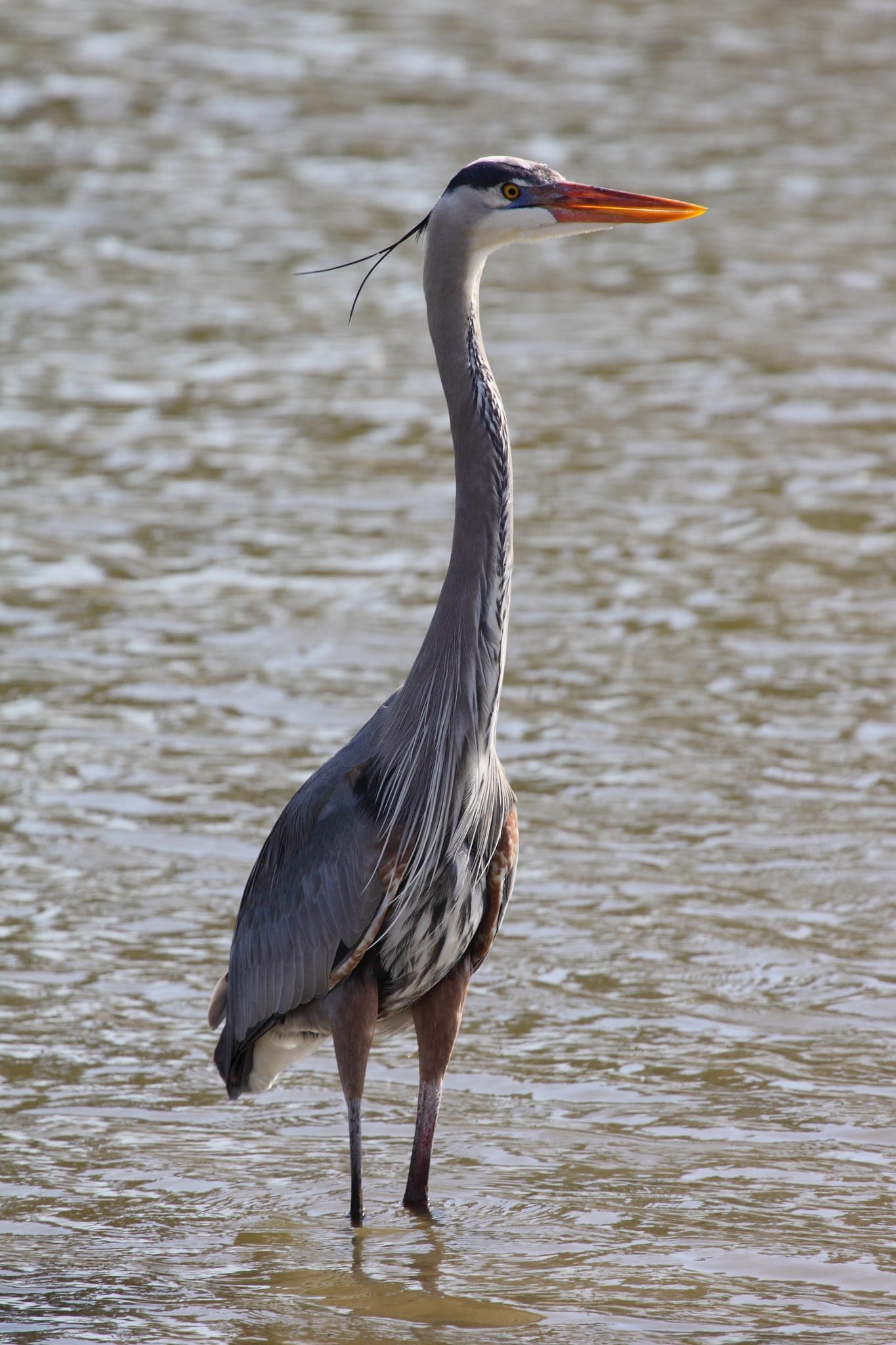
From a distance a great blue heron looks blue-gray, but up close the colors are subtle: a white face and crown edged by a broad black stripe that runs from above the eye to the back of the head and ends in black plumes, a grayish neck with a streaky black-and-white front, rusty thighs, and a black-and-chestnut patch at the bend of the wing. The bill is long, heavy and yellowish, and the legs are long and dark. Breeding adults grow shaggy plumes on the lower neck and back; juveniles are duller, with a dark cap and no head plumes. In flight the neck folds into a tight S with the head resting on the shoulders, the legs trail well past the tail, and the wingbeats are deep and slow. South Florida and the Keys add two odd forms: the all-white great white heron, with a yellow bill and pale legs, and Wurdemann's heron, a blue-gray bird with a white head.
- Huge size: about 4 ft tall, the largest North American heron
- White face with a black stripe over the eye ending in plumes
- Heavy, daggerlike yellowish bill and long dark legs
- Neck folded in an S and legs trailing in flight
- Deep, harsh croak when it flushes
Look-alikes
Sandhill Crane
Cranes fly with the neck stretched straight out, wear a red patch on the forehead, and usually feed in fields in pairs or flocks while giving a loud, rolling bugle. A heron folds its neck in flight and hunts alone at the water's edge.
Great Egret
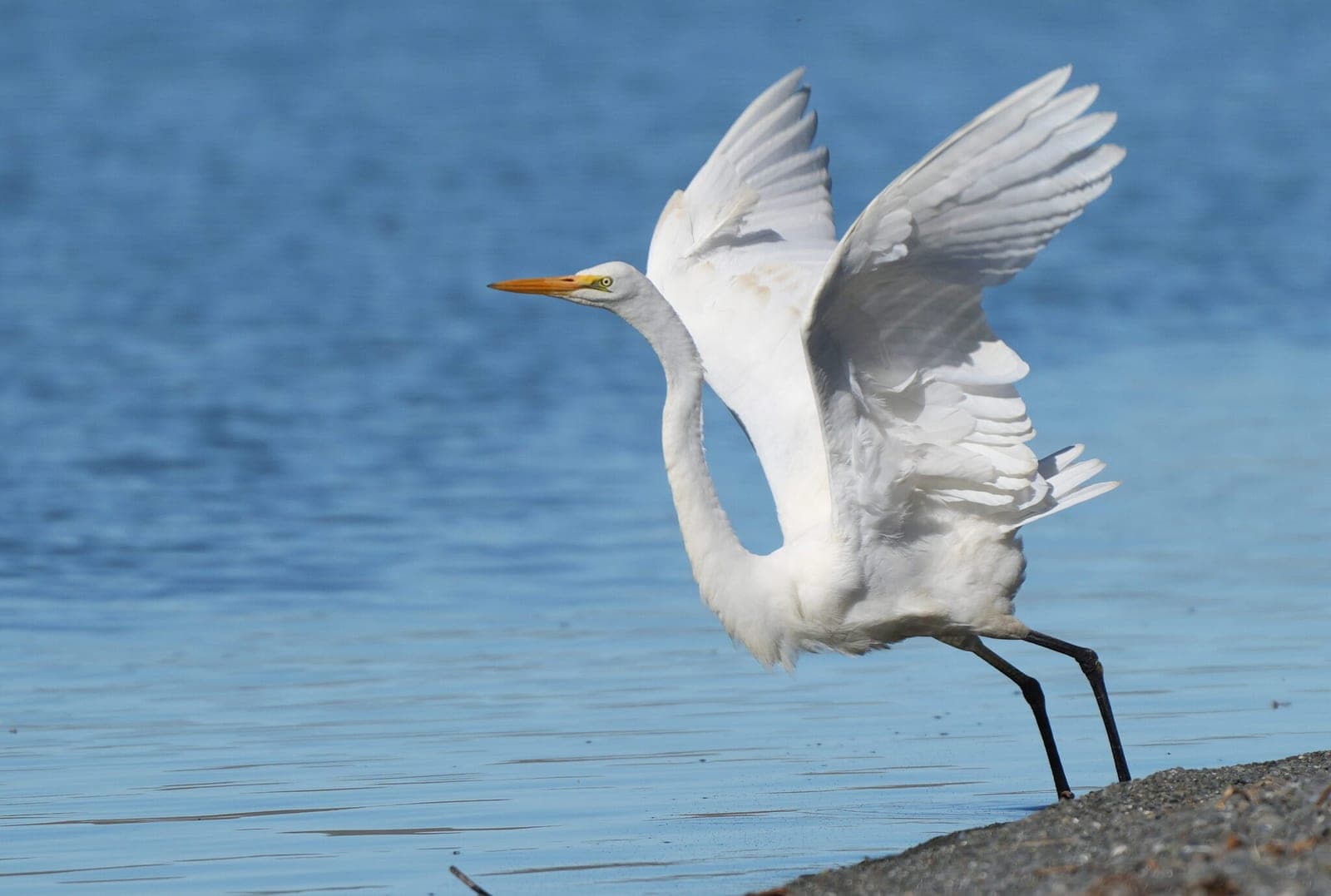
Great egrets are pure white with a yellow bill and black legs, and noticeably slimmer and lighter. The white great white heron of south Florida is bulkier than an egret, with a heavier bill and pale yellowish legs.
Full comparison →Little Blue Heron
Barely half the height, dark slate-blue all over with a purplish neck and a bluish bill tipped in black. It has no white face or black head stripe and is found mostly in the Southeast.
Range & habitat
Great blue herons breed from southeastern Alaska and southern Canada across almost all of the lower 48 states and into Mexico, with resident birds in the Caribbean and the Galápagos. Northern birds east of the Rockies migrate, many to the southern United States, the Caribbean, Central America and northern South America, but plenty stay as far north as they can find open water. On the Pacific Coast many are year-round residents as far north as southeastern Alaska. The white form lives mainly in the Florida Keys and the Caribbean.
Almost any calm, shallow water with fish suits a great blue heron: marsh edges, slow rivers, beaver ponds, farm ponds, lake flats, mangroves, tidal flats and the rocks below dams. They usually wade in water less than about 20 inches deep, and also hunt from docks and floating logs and stalk voles and gophers in mowed fields. Colonies sit high in tall trees, often on islands, in flooded timber or in beaver swamps, where water and isolation keep raccoons and people at bay, and birds may commute several miles from the colony to feed.
Through the seasons
Spring
Northern birds return as soon as ice leaves the shallows, often in March or April, and settle back into traditional heronries. Males claim nests and display, pairs rebuild big stick platforms, and colonies are most easily disturbed in this early stretch before eggs hatch.
Summer
Colonies are loud with begging chicks, which can fly at around two months and leave the nest at two to three months. In late summer young herons scatter in every direction, and some wander well north of where they hatched.
Fall
Northern herons drift south through fall, alone or in loose flocks, by day or night. Many linger until ponds and marshes freeze, hunting river edges and lake flats into November.
Winter
No North American heron winters farther north: herons hold out wherever water stays open, from spring-fed creeks and dam tailwaters to coastal marshes. Across the South and along the Pacific Coast, resident birds are joined by migrants from the North.
How to find and watch great blue herons
Great blue herons are easy to see but quick to flush, and they hunt at dawn, at dusk and even at night. Calm early mornings on shallow water give the best looks at the slow stalk and the lightning strike.
- Scan weed edges, riffles, beaver ponds and tidal flats at first light; a heron standing still looks like a stump until it moves.
- Listen for a deep, harsh croak as a bird lifts off, often the first sign one was there.
- In winter, check open water below dams and at spring-fed outlets, where herons concentrate.
- Approach slowly and at an angle; walking straight at a heron or moving quickly sends it off.
- Find heronries in late winter, before the leaves come out, then watch them from a road, trail or across the water with a spotting scope.
- Back off if birds stand up on their nests, call in alarm or flush; repeated disturbance can make a colony fail.
- Net an ornamental fish pond if a heron starts raiding it; herons are protected and may not be harmed.
Diet & life cycle
What it eats
Fish make up most of the diet, usually 4 to 8 inches long, though herons can swallow fish close to 2 feet long. They also take frogs, salamanders, snakes, turtles, crayfish, insects, small birds and, in fields, voles and gophers. A heron seizes prey with a lightning thrust of its neck, made possible by specially shaped neck vertebrae, and swallows it whole, headfirst.
Life cycle
Great blue herons nest in colonies that range from a handful to several hundred nests, usually 20 to 60 feet up in tall trees and sometimes on the ground on islands free of predators. The male picks the nest site and displays to attract a mate; he gathers most of the sticks and she does most of the building. The female lays 3 to 5 pale blue eggs, and both parents incubate for about 25 to 30 days and feed the chicks by regurgitation. Young fly at about two months and leave the colony at roughly two to three months. Northern pairs raise one brood a year, while some southern pairs raise two. Bald eagles raid colonies, and crows, ravens and turkey vultures take eggs and chicks.
Oldest on record
The oldest great blue heron in the USGS Bird Banding Laboratory's longevity table was at least 24 years 6 months old. It was banded as a nestling in Texas in June 1977 and found dead in Texas in December 2001.
SourceAttracting & watching
Great blue herons do not come to feeders, and in yards they usually show up only to raid fish ponds. The best watching is at wetlands: national wildlife refuges, state wildlife areas, city park lakes and marsh boardwalks, where herons used to people allow close views. Heronries are the big show from March through June, best enjoyed from a road, a trail or across water with binoculars or a scope; walking under the trees can flush adults and leave eggs and chicks to crows and ravens. In winter, open water below dams and along coastal marshes reliably holds birds.
Conservation
Least Concern (IUCN); Pacific subspecies of Special Concern in Canada. Great blue herons are common and widespread, with an estimated 700,000 birds, and North American numbers have held steady or grown in recent decades. Once shot freely as easy targets and fish-eaters, they are now protected under the Migratory Bird Treaty Act. The Pacific subspecies, fannini, of coastal British Columbia is listed as Special Concern under Canada's Species at Risk Act, with bald eagle predation, development and disturbance at colonies as the main threats.