How to identify a yellow-rumped warbler
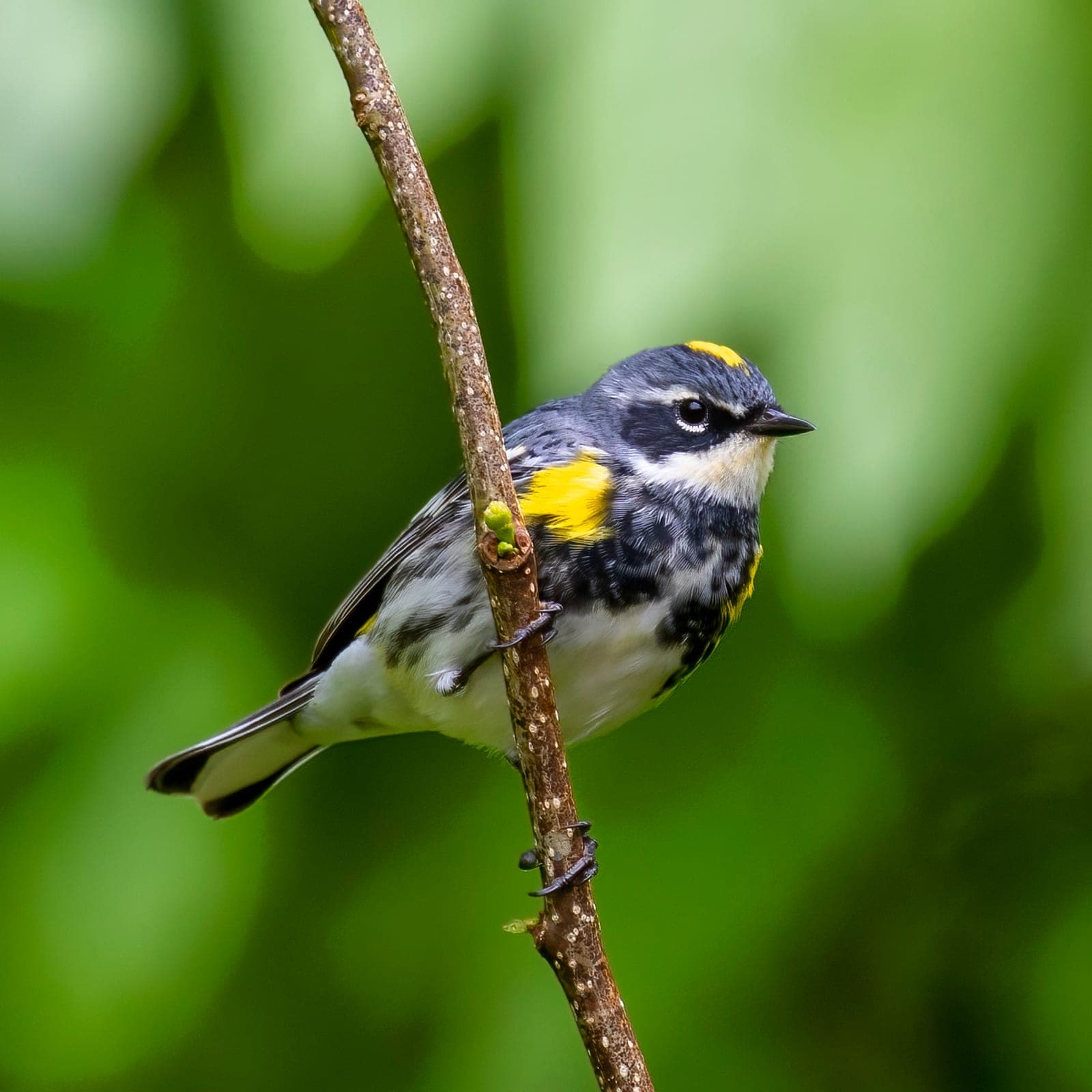
Every Yellow-rumped Warbler, in every plumage, has a bright yellow rump patch and a small yellow patch on each side of the chest. Spring males are slate gray with black streaks on the back, a black chest, a yellow crown patch and white in the wings and tail. There are two common forms. The eastern 'Myrtle' Warbler has a white throat that wraps up behind a dark cheek patch and a thin white eyebrow. The western 'Audubon's' Warbler has a yellow throat and a plainer gray face. Females are browner and duller, and fall and winter birds are brownish and streaky, but the yellow rump, a hint of yellow on the sides and the loud 'check' call give them away. They are restless, flitting foragers that often sally out after flying insects like a flycatcher.
- Bright yellow rump, obvious as the bird flies off
- Small yellow patch on each side of the chest
- White throat (Myrtle) or yellow throat (Audubon's)
- White spots in the outer tail feathers
- Sharp, loud 'check' call, especially in fall and winter
Look-alikes
Magnolia Warbler
Magnolias also have a yellow rump, but their whole underside is yellow with black streaks, and the tail shows a broad white band across its middle. Yellow-rumps are white or pale below with yellow only on the sides.
Palm Warbler
Palm Warblers forage on the ground and pump their tails constantly. They have bright yellow under the tail rather than on the rump, a rusty cap in spring, and no yellow side patches.
Pine Warbler
Pine Warblers have a yellow throat and breast, a plain olive back and white wing bars, but no yellow rump patch. They usually forage in pines.
Range & habitat
The Myrtle form breeds in the boreal forest from Alaska across Canada to Newfoundland, south into the northern Great Lakes states and New England. Audubon's Warblers breed in the mountain forests of the West, from British Columbia to California and through the Rockies east to the Dakotas, up to about 12,000 feet. In winter both forms move south and to the coasts: Myrtles across the southeastern United States, up the Atlantic Coast to New England and along the Pacific Coast, Audubon's through the western lowlands and the Southwest, and both into Mexico, Central America and the Caribbean.
For nesting they need conifers: spruce, fir, pine, hemlock and tamarack, or mixed woods with aspen and birch, often in open stands, edges and bogs rather than dense forest. In migration and winter they turn up almost anywhere there is food, from open woods, thickets, parks and gardens to coastal dunes covered in bayberry and wax myrtle, and streamside woods in the West.
Through the seasons
Spring
Yellow-rumps migrate earlier in spring than other warblers, and in April they are often the first warblers birders see, flycatching from bare branches over water while males molt into crisp gray, black and yellow.
Summer
Pairs nest in conifers, usually raising two broods. Males forage higher in the trees than females. Look for them in the boreal forest, the Northeast and western mountain conifer forests.
Fall
They are among the last warblers to move south, and from September into November flocks pour through, many lingering along the coasts. They switch more and more to berries as insects disappear.
Winter
This is the main winter warbler of North America. Flocks feed on bayberry, wax myrtle, juniper and poison ivy berries, and some birds visit suet feeders, sometimes as far north as New England and Seattle.
How to find and attract Yellow-rumped Warblers
Few warblers are as easy to find. In migration and winter, listen for the 'check' call in any shrubby or wooded patch with berries, and watch for the yellow rump as a bird flits off. Berry plants and suet will bring them into a yard.
- Plant waxy-berried shrubs such as northern bayberry and wax myrtle, plus junipers like eastern redcedar.
- Offer suet, peanut butter, sunflower hearts and raisins in late fall and winter.
- Learn the sharp 'check' call; a flock in a berry thicket can be heard before it is seen.
- In early spring, check sunny edges and trees over water, where they sally out for flying insects.
- For breeding birds, visit conifer forests in the North and the western mountains in June.
- Leave poison ivy and Virginia creeper in a wild corner; their berries feed wintering flocks.
Diet & life cycle
What it eats
Yellow-rumped Warblers are among the most flexible feeders of any warbler. In summer they eat caterpillars, beetles, ants, aphids, gnats, wasps and grasshoppers, plus spiders, gleaning foliage, hovering and catching insects in midair; they also feast on spruce budworm during outbreaks. In winter they rely on berries, especially bayberry and wax myrtle, and they are the only warbler known to digest the wax coating on those fruits, which lets them winter farther north than their relatives. They also eat juniper berries, poison ivy, grapes, Virginia creeper and some seeds.
Life cycle
During courtship the male follows the female closely, fluffing his side feathers, raising his wings and crown and fluttering. She builds an open cup of twigs, bark fibers, needles and rootlets on a horizontal branch of a conifer, usually 4 to 50 feet up, and lines it with hair and feathers that often curl over the eggs. She lays four or five creamy, brown-marked eggs, sometimes three, and incubates them for 12 to 13 days. Both parents feed the young, which leave the nest after 10 to 12 days and can fly short distances a few days later. Most pairs raise two broods a year.
Oldest on record
The oldest Yellow-rumped Warbler in the USGS Bird Banding Laboratory longevity table was a female at least 10 years old. She was banded in Wyoming in July 1998, already an adult, and recaptured and released in Wyoming in June 2006.
SourceAttracting & watching
Yellow-rumps are among the few warblers that use feeders: suet, peanut butter, sunflower hearts and raisins bring them in during fall and winter. Waxy-berried shrubs such as bayberry and wax myrtle, plus junipers, poison ivy left in a wild corner and an open birdbath, make a yard a winter stop. In spring, watch for them flycatching over ponds and streams. They are protected under the Migratory Bird Treaty Act.
Conservation
Least Concern (IUCN). This is one of North America's most abundant birds, with Partners in Flight estimating about 170 million, and the Breeding Bird Survey shows its numbers holding steady from 1966 to 2019. Its ability to switch between insects and berries, and to winter far north, helps keep it common.